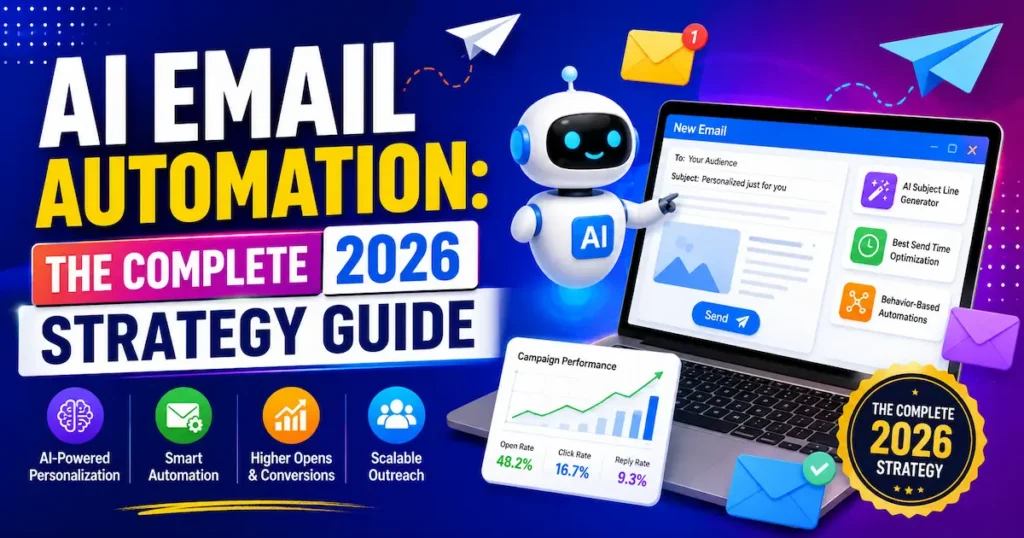
AI email automation revolutionizes how businesses handle communications, blending intelligent tools with seamless workflows. Companies worldwide now leverage this technology to personalize messages at scale and boost engagement. This guide by The Futuristics walks you through every step, with real-world examples from the US, UK, Australia, and Canada.
Why Email Automation Matters Today?
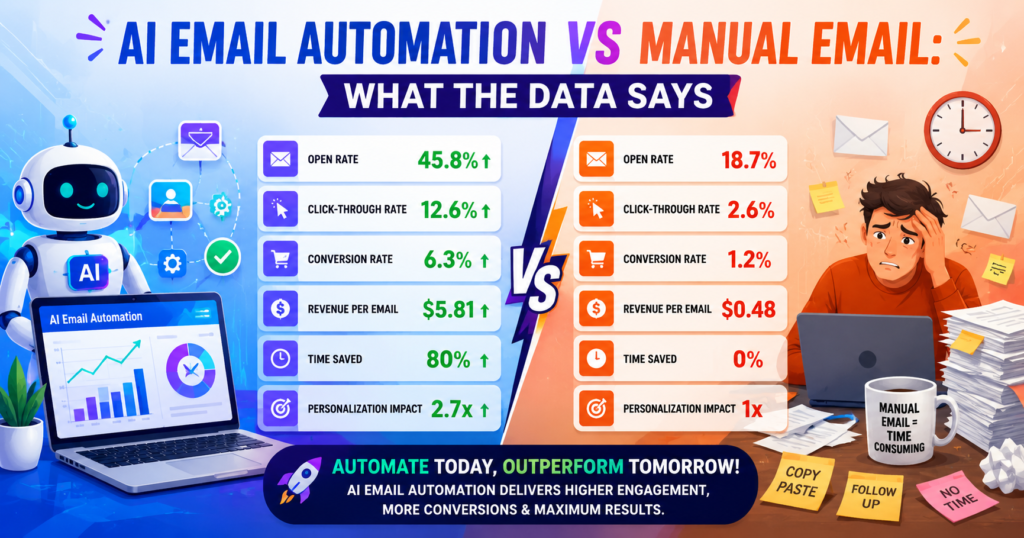
Businesses adopt email automation to handle repetitive tasks efficiently. Automated emails generate 320% more revenue than non-automated ones, according to recent stats. In high-paying markets like the US, where email ROI hits $36 per $1 spent, this tech drives massive returns.
Workflow automation takes it further by predicting customer needs and triggering timely actions. Marketers using AI cut campaign production time by 40% while improving personalization.
For UK e-commerce firms, this means higher open rates up-to 70% in some cases.
Global adoption surges as 37% of email pros integrate AI for efficiency.
Key Benefits of Email Automation
AI transforms basic automation into smart systems that learn and adapt.
- Higher Engagement: Personalized automated emails achieve 6x transaction rates over generic ones.
- Time Savings: Teams reduce manual work by 40%, focusing on strategy instead.
- Revenue Growth: Flows like abandoned carts yield $3.65 per recipient on average.
- Scalability: Handle thousands of emails daily without adding staff.
Top Tools for Email Automation
Select platforms based on your needs, like e-commerce, CRM integration, or no-code ease.
Tool | Best For | Starting Price | Key AI Feature | Example Use |
ActiveCampaign | SMBs with CRM | $29/month | Lead scoring | US real estate nurturing leads |
Klaviyo | E-commerce | Free tier | Predictive analytics | Australian fashion brands recovering carts |
HubSpot | Marketing teams | Free tools | Email writer AI | UK agencies scaling outreach |
Zapier | No-code workflows | Free tier | AI steps in Zaps | Canadian startups automating Gmail |
Make.com | Custom AI agents | Free tier | GPT integration | US agencies building autoresponders |
Omnisend | E-com + SMS | $11.20/month | Abandoned cart flows | Aussie retailers boosting ROI |
These tools integrate AI for drafting, segmenting, and sending. Zapier and Make.com shine for workflow automation.
Step 1: Define Your Email Goals
Start by mapping objectives clearly. Identify triggers like sign-ups, purchases, or inactivity.
- Ask: What actions drive revenue? For a US SaaS firm, focus on trial-to-paid conversions.
- List 3-5 workflows:
- Welcome series for new subscribers.
- Abandoned cart reminders.
- Re-engagement for dormant users.
Use tools like Google Sheets to sketch flows. This planning prevents overload later.
Step 2: Choose & Set Up Your Platform
- Pick a tool from above based on scale. Sign up for ActiveCampaign or Zapier for starters.
- Connect accounts: Link Gmail, CRM like HubSpot, or e-commerce like Shopify. Verify integrations work.
For workflow automation:
- Create a free account.
- Add your email provider (e.g., Gmail module).
- Test a basic trigger, like new subscriber.
Step 3: Build Triggers and Segments
Triggers launch automations, new leads, opens, or clicks.
In Zapier, set “New Email Matching Search” as a trigger.
Segment audiences by behavior: high-risk churners get win-back offers.
AI enhances this:
- Use NLP for intent detection.
- Segment via AI descriptions in Klaviyo.
Step 4: Craft AI-Powered Content
AI drafts personalized copy fast. HubSpot’s writer generates sales outreach in the tone you choose.
Prompt tips:
- “Write a friendly abandoned cart email for [product], personalize with [name].”
- Add delays for human-like pacing.
In Make.com:
- Extract sender data with GPT.
- Draft reply: “Hi [name], noticed you eyed our [item]…”
- Send via Gmail.
Step 5: Integrate Workflow Automation
Link steps into full flows. Use Zapier for Gmail-to-Docs summaries or Make.com agents.
Example flow for US agencies:
- Trigger: New lead email.
- AI: Extract needs, draft reply.
- Action: Send, tag CRM.
Add sentiment analysis to prioritize urgent replies. For the Canada-UK cross-border, automate time zone delays.
Step 6: Test and Launch Workflows
Run dry tests. Send it to yourself first.
Check:
- Delivery (avoid spam folders).
- Personalization accuracy.
- Mobile rendering.
A/B test subjects: AI generates variants. Launch a small 10% list, then scale.
Monitor initial sends closely.
Step 7: Monitor, Optimize, and Scale
Track metrics: opens (aim 70%+ automated), clicks, ROI ($36:1 average). Tools auto-report. Optimize with AI insights, and adjust segments if churn rises.
Scale globally: US firms add SMS via Omnisend for Aussie markets. Revisit quarterly. Automation improves 96% with personalization tweaks.
Real-World Examples
United States-US: Every Man Jack used Klaviyo AI for churn prediction, segmenting high-risk buyers, and growing revenue 25% YoY.
United Kingdom-UK: Act-On Integration achieved 75% opens, 70% conversions for events via Dynamics AI.
Australia: Omnisend E-com recovers carts with AI, hitting top ROI in retail.
Canada: Zapier Flows Startups automate Gmail-CRM syncs, prepping for US entry.
These cases show 320-7200% ROI potential.
Common Pitfalls to Avoid
- Rushing setup leads to spam flags—warm inboxes first.
- Overlook compliance: GDPR for UK/EU, CAN-SPAM for US/Canada.
- Ignore mobile: 50%+ opens happen there. Test rigorously.
Start small to build wins.
Frequently Asked Questions
AI email automation uses machine learning to draft, send, and optimize emails based on user behavior. It goes beyond rules-based systems by predicting needs.
Workflow automation AI orchestrates multi-step processes intelligently, like sentiment-based routing. Traditional tools rely on if-then rules.
ActiveCampaign tops for SMBs with CRM and lead scoring at $29/month. It delivers 3600% ROI averages.
Yes, Omnisend excels with cart recovery and SMS, boosting revenue 320% via personalization.
Using Make.com, build one in 30-40 minutes: trigger, extract, draft, send.
Absolutely, personalized AI flows hit 70% opens, per case studies.
Zapier connects Gmail triggers to AI summaries or replies seamlessly.
Expect $36 per $1 spent, up to 7200% in US e-com; automated flows shine at 30x returns.
Yes, platforms like Zapier let you build without coding via simple prompts.
Adding delays, personalizing heavily, and following sender guidelines keep bounces low.
You can explore more information by clicking here.