
Automated emails account for roughly 2% of everything an online store sends and around 30% of the revenue. That gap is the entire argument for AI email automation for ecommerce, and it’s why the stores winning in 2026 aren’t sending more emails. They’re sending fewer, smarter, better-timed ones.
The Futuristics, in this guide you’ll get the six flows that actually make money, a side-by-side comparison of the tools that power them, real pricing for the USA, UK, Canada and Australia, and the mistakes that quietly kill results. No theory. Just what works when you set it up properly.
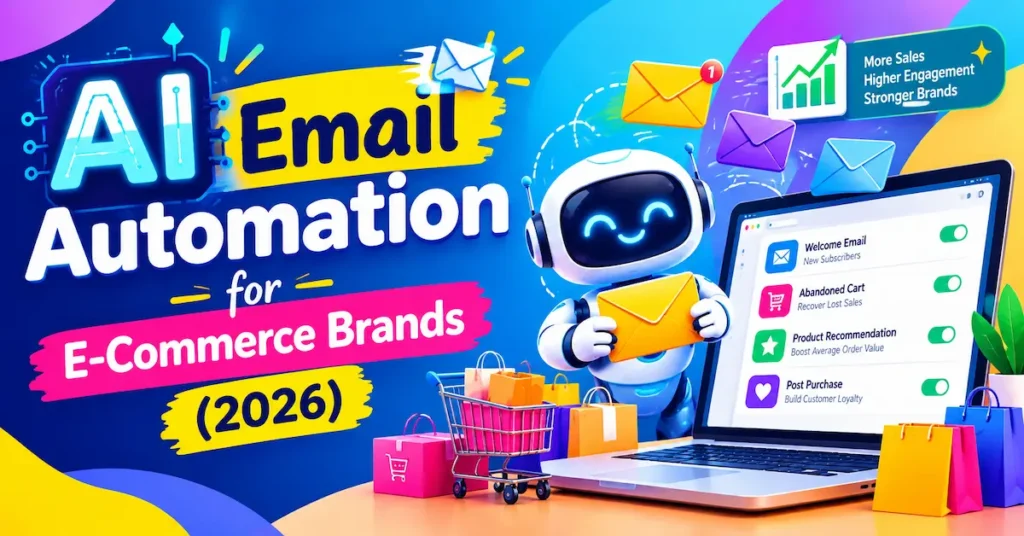
What AI Email Automation for E-Commerce Actually Does
Forget the marketing language for a second. AI email automation for ecommerce means three specific jobs are handled by software instead of you.
Job one: deciding who gets what. AI segmentation looks at browsing, purchase history, order value and time-since-last-purchase, then builds the audience for you. In Klaviyo you can now describe a segment in plain English and it builds it. Omnisend has an AI segment builder that works the same way.
Job two: writing and choosing the content. Subject line generation, brand-voice copywriting, and product recommendation blocks that pick different items for different people inside the same email.
Job three: timing the send. Predictive send-time features look at when each subscriber historically opens, then stagger delivery per person rather than blasting everyone at 9am.
What changed in 2026
The big shift is agents. Klaviyo’s Marketing Agent takes a natural-language brief and returns a drafted campaign or flow, ready for you to review. Customer.io has a similar agent layer.
The important word there is review. These tools draft you approve. Anyone selling you a fully hands-off email program is overselling it.
Key Takeaway: AI email automation handles segmentation, copy and send timing, but the send-approval decision should still be yours.
The 6 AI Email Flows That Make E-Commerce Stores the Most Money
Three flow types abandoned cart, welcome, and browse abandonment account for the vast majority of all automated ecommerce orders. Build these first, in this order.
1. Welcome series (3 emails)
Triggered when someone joins your list. Welcome emails pull open rates north of 80% because interest is at its peak.
Send email one immediately with the offer they signed up for. Email two after 24 hours introducing the brand. Email three after two days with your bestsellers.
2. Abandoned cart (3 emails)
Around 70% of carts get abandoned. A three-email sequence recovers meaningfully more orders than a single reminder.
Hour one: a simple nudge, no discount. Day one: social proof or reviews. Day three: the incentive, if you use one.
3. Browse abandonment
Someone viewed a product and left without adding to cart. Weaker intent than a cart, but far higher volume which is why it earns its place in the top three.
4. Post-purchase
Order confirmation, shipping updates, then a review request around day 10. This is where AI product recommendations do their best work, because you now know exactly what they bought.
5. Back-in-stock
The highest-converting automated email type in ecommerce. The intent signal is unambiguous they asked to be told.
6. Win-back
For customers who’ve gone quiet past your typical repurchase window. Lowest revenue per recipient of the six, so build it last.
📊 Automated emails made up just 2% of all ecommerce email sends in 2025 but generated 30% of total email revenue — earning 16× more per send than scheduled campaigns. — Omnisend 2026 Ecommerce Marketing Report
💡 Pro Tip: Build your abandoned cart flow before your welcome flow if you already have traffic. Cart traffic exists today; list growth takes weeks. You’ll see revenue inside a fortnight instead of a month.
Key Takeaway: Welcome, abandoned cart and browse abandonment drive the bulk of automated ecommerce orders, so build those three before anything else.
Best AI Email Automation Tools for E-Commerce in 2026
1. Klaviyo
Best for: Data-heavy Shopify brands wanting predictive AI
Free Plan: Yes — 250 profiles, 500 sends/month
Starting Price: $20/month (~£15)
Rating: ⭐⭐⭐⭐⭐ 4.8/5
2. Omnisend
Best for: Best all-round value for small-to-mid-sized stores
Free Plan: Yes — 250 contacts, 500 emails/month
Starting Price: $16/month (~£12)
Rating: ⭐⭐⭐⭐⭐ 4.7/5
3. Brevo
Best for: High send volume on a tight budget
Free Plan: Yes — 300 emails/day
Starting Price: $9/month (~£7)
Rating: ⭐⭐⭐⭐½ 4.4/5
4. Drip
Best for: DTC and subscription brands needing deep automation logic
Free Plan: No — 14-day trial
Starting Price: $39/month (~£29)
Rating: ⭐⭐⭐⭐½ 4.3/5
5. ActiveCampaign
Best for: Complex branching workflows plus built-in CRM
Free Plan: No — 14-day trial
Starting Price: $15/month (~£11)
Rating: ⭐⭐⭐⭐½ 4.5/5
6. Mailchimp
Best for: Beginners who want a gentle learning curve
Free Plan: Yes — limited contacts and sends
Starting Price: $13/month (~£10)
Rating: ⭐⭐⭐⭐ 3.9/5
For most stores under 10,000 contacts, Omnisend gives you the best ratio of ecommerce features to monthly cost, while Klaviyo is worth the premium once predictive analytics and revenue attribution genuinely change your decisions.
One pricing trap to watch
Klaviyo bills on active profiles any contact you could email, not just the ones you do. A quiet list still costs you money, and the jump from 10,000 to 25,000 profiles is steep.
Brevo bills on sends instead of contacts, which flips the maths entirely if you have a big, lightly-emailed list.
Key Takeaway: Choose your AI email automation tool based on its billing model and data depth, not its headline starting price.
How to Set Up AI Email Automation for Your Store in 5 Steps
You can have your first two flows live in an afternoon. Here’s the order that avoids rework.
Step 1: Connect your store properly. Install the native app for Shopify, WooCommerce or BigCommerce not a Zapier workaround. Native integrations pass product, cart and order data, which is what every AI feature runs on.
Step 2: Clean the list before you import. Remove anyone who hasn’t opened in 12 months. Deliverability improves immediately, and on profile-based platforms you stop paying for dead weight.
Step 3: Turn on the pre-built flows, then edit. Every tool ships with templated welcome and cart sequences. Start there and rewrite the copy the default templates read like defaults.
Step 4: Let AI draft, then cut. Generate three subject lines, pick one, shorten it. AI copy tends toward padding; your job is subtraction.
Step 5: Switch on predictive send time and review after 30 days. Give the model enough data to learn before you judge it.
Set your consent rules first
This part isn’t optional and it varies by market. In the UK, PECR plus UK GDPR means marketing emails need clear opt-in and an easy unsubscribe.
Canada’s CASL is stricter still, with express consent requirements and real financial penalties. Australia’s Spam Act 2003 requires consent, accurate sender identification and a working opt-out in every message.
💡 Pro Tip: Add a one-line preference centre to your welcome email asking how often people want to hear from you. Subscribers who choose their own frequency unsubscribe far less — and it’s a compliance win in all four markets.
Key Takeaway: Native store integration and clean consent records do more for AI email automation results than any individual AI feature.
What AI Email Automation Costs in the USA, UK, Canada and Australia
Almost every platform here bills in USD regardless of where you’re based, so UK, Canadian and Australian stores should expect a small currency conversion spread on top of the listed price.
A realistic starting budget for a store with 1,000–2,500 contacts is $30–$60 per month, or roughly £22–£45. That’s the software only.
SMS changes the maths
SMS is where budgets quietly break. Klaviyo’s SMS coverage is limited to a subset of countries, which matters if you’re selling into Australia or Canada from a US-registered account — check your market is supported before you build the flow.
Omnisend offers broader global SMS coverage, but as of May 2026 new customers need the Pro plan to send SMS at all. Brevo includes SMS across plans, which is why budget-conscious UK sellers often land there.
📌 Real Example: A cosmetics retailer in Canada INGLOT Cosmetics Canada used Omnisend’s automated cart-abandonment workflow combining email, SMS and push notifications to achieve a 117% increase in conversion rate over email-only promotions and a 2,130% lift in revenue per message. (Omnisend case study)
In Australia, NSW-based brand Bowy Made now generates over 70% of its revenue from automated flows after adding product and browse abandonment sequences a five-figure revenue jump in a single month from a small team.
Key Takeaway: Budget $30–$60 (£22–£45) monthly to start, and confirm SMS availability in your market before you design a multichannel flow.
5 Mistakes That Kill AI Email Automation Results
Most underperforming programs fail for boringly practical reasons.
Mistake 1: Sending to everyone. Best AI email automation tool makes it trivially easy to email your whole list. Resist it. Suppression logic excluding recent purchasers, excluding people already in another flow is what separates a 30× program from an average one.
Mistake 2: Trusting AI copy without editing. Generated subject lines skew generic and slightly too long. Read them out loud; if it doesn’t sound like your brand, rewrite it.
Mistake 3: Measuring open rates. Open rate has been unreliable since privacy protections started pre-loading images. Track revenue per recipient instead it’s the only number that reflects reality.
Mistake 4: Building all six flows at once. Half-finished flows perform worse than two properly tuned ones. Launch welcome and cart, run them for a month, then expand.
Mistake 5: Ignoring the discount ladder. If every cart email opens with 15% off, you’ve trained your customers to abandon carts. Hold the discount back to email three, and test removing it entirely.
One thing worth doing quarterly
Re-check your flow exit conditions. Stores that scale fast often end up with customers sitting in three flows simultaneously, receiving four emails a day, and unsubscribing for reasons nobody notices in the dashboard.
Key Takeaway: Suppression rules, honest metrics and a slow rollout matter more than which AI features your platform advertises.
Frequently Asked Questions
It's the use of AI-powered software to trigger, personalise and time emails based on customer behaviour rather than a manual schedule. The system decides who receives what and when, based on actions like abandoning a cart or viewing a product. You build the flow once, and it runs continuously.
Entry plans start around $9–$20 per month (roughly £7–£15) for a few hundred contacts. A store with 1,000–2,500 contacts typically pays $30–$60 (£22–£45) monthly. Costs scale with list size on most platforms, and SMS is billed separately.
Yes, particularly for abandoned cart recovery, because the revenue comes from traffic you've already paid for. Most stores recoup a $20 monthly subscription from a single recovered order. Start on a free plan if you're under 250 contacts.
It can get close if you feed it examples of your existing copy and set a brand voice profile. Klaviyo's Composer and Omnisend's AI Writer both support this. Treat the output as a first draft the editing pass is where the brand voice actually lands.
Klaviyo is the default for data-heavy brands that want predictive analytics and revenue attribution. Omnisend is the better value choice for small and mid-sized stores wanting email, SMS and push in one place. Both have highly rated native Shopify apps.
Because they arrive during a window of real intent. Someone who just abandoned a cart is far closer to buying than someone receiving a scheduled newsletter. That timing advantage is why automated emails earn several times more revenue per send.
The tools provide the mechanics consent capture, unsubscribe links, suppression lists but compliance is your responsibility. UK GDPR and PECR require clear opt-in; Canada's CASL requires express consent with records. Australia's Spam Act 2003 has similar requirements.
A welcome series and abandoned cart flow can be live in two to four hours using pre-built templates. Expect another few hours to rewrite the copy properly. Meaningful performance data takes about 30 days.
Benchmarks put average abandoned cart flows at roughly 3% of recipients placing an order, with top performers going considerably higher. If you're below 2%, look at your timing and the strength of your first email. Anything above 5% is strong.
Yes Klaviyo, Omnisend, Brevo and ActiveCampaign all offer WooCommerce integrations that pass cart and order data. Feature parity is generally good, though some newer AI features ship to Shopify first. Check the specific integration before committing.
Final Thoughts
AI email automation for ecommerce works because it swaps guesswork for timing: a small fraction of your sends, triggered by real behaviour, ends up carrying a disproportionate share of your revenue. Build welcome, abandoned cart and browse abandonment first, email subject lines pick a tool based on how it bills rather than its sticker price, and keep a human hand on the send button. The mistakes that matter no suppression rules, unedited AI copy, six half-built flows are all avoidable.
Pick one flow, build it this week, and let the next 30 days of data tell you where to go next.