
ActiveCampaign vs HubSpot is the decision that keeps small teams stuck for weeks, and the wrong pick can quietly add hundreds of dollars to your monthly bill. Both platforms now promise AI that writes emails, scores leads and runs follow-ups while you sleep. Their pricing, setup and AI limits are very different, though.
In the futuristics, this guide compares both tools on AI email automation, real 2026 pricing and ease of use. You’ll see where each one wins, what the AI actually costs, and which fits freelancers and small businesses in the USA, UK, Canada and Australia. Let’s start with the differences that decide most purchases.
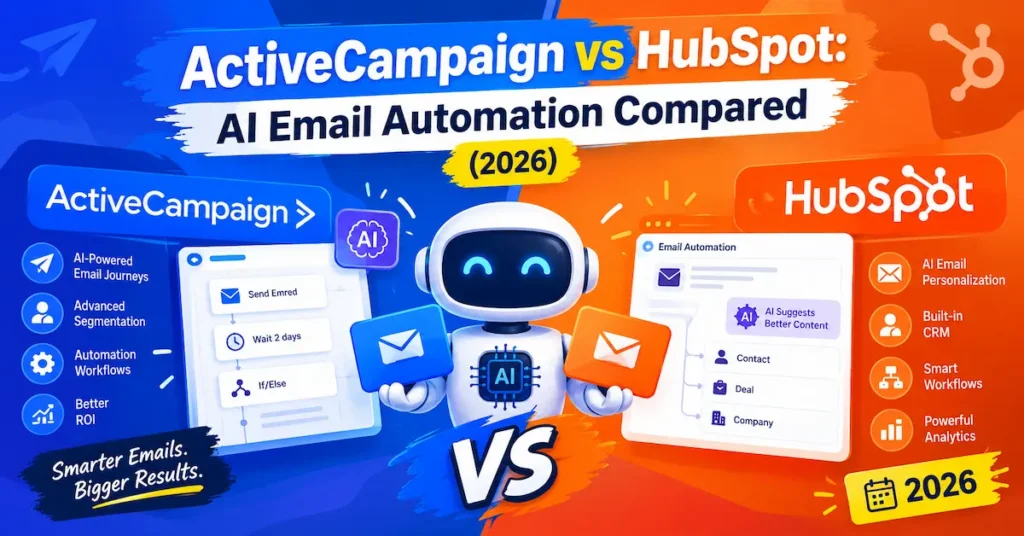
ActiveCampaign vs HubSpot: 3 Differences That Matter Most
Both tools send emails. That’s where the similarity ends.
📊 35% of companies earn between $10 and $36 for every $1 spent on email marketing — Litmus State of Email, 2025
Email still pays, so the platform behind it matters.
1. Core Focus
ActiveCampaign is built around automation. You design visual journeys that react to clicks, purchases and tags. HubSpot is a full CRM first, and email is one hub among many.
2. Pricing Model
ActiveCampaign charges by contact count. HubSpot charges per seat and adds contact-tier costs on top. That means HubSpot bills climb faster as your list grows.
3. AI Access
ActiveCampaign’s AI tools sit inside its higher plan tiers. HubSpot’s Breeze AI meters many features through credits, so heavy use costs extra.
Key Takeaway: ActiveCampaign is the automation specialist with predictable pricing, while HubSpot is the all-in-one CRM with a more complex bill.
AI Email Automation Features Compared
AI is where the gap between these tools shows up fastest. Here’s what each one actually offers in 2026.
ActiveCampaign’s AI Tools
ActiveCampaign includes AI-generated content and predictive sending, which picks the best send time per contact. These sit above the entry-level Starter plan. Unlimited automations arrive from Plus upward.
The real strength is behavior-based logic. You can tag a contact after a link click, omnisend vs mailchimp ai features move them into a sales pipeline, and trigger a follow-up without touching anything.
HubSpot Breeze AI
HubSpot’s AI suite is called Breeze. Breeze Assistant drafts emails, summarises CRM records and builds reports. Breeze Agents handle jobs like customer conversations and prospecting.
Spring 2026 also added AI-agent branches that can route contacts inside workflows. That’s powerful, but the workflow builder itself only comes with Marketing Hub Professional and above. Starter gives you basic email sequences, not true automation.
The Credit Catch
Every Breeze AI action consumes HubSpot credits. Monthly allowances are roughly 500 on Starter, 3,000 on Professional and 5,000 on Enterprise. Extra credits cost about $10 per 1,000 (around £8).
Some agents are now priced per outcome. For example, the Customer Agent charges $0.50 per resolved conversation.
Key Takeaway: ActiveCampaign gives you AI-driven automation at a flat rate, while HubSpot gives you broader AI that you pay for as you use it.
Pricing Breakdown for the USA, UK, Canada and Australia
Sticker prices look similar at the bottom. They stop looking similar quickly.
ActiveCampaign Pricing
Annual-billing prices for 1,000 contacts are:
- Starter: $15/month (≈ £11)
- Plus: $49/month (≈ £37), the most popular tier
- Pro: $79/month (≈ £59)
- Enterprise: from $145/month (≈ £109)
There’s no free plan, only a 14-day trial. Prices are listed in USD, so Canadian and Australian users should check their card’s foreign-exchange fees.
HubSpot Pricing
Marketing Hub Starter costs about $15 per seat, or £18 per seat in the UK. Professional starts around $890/month (≈ £670). Reviews also report a mandatory onboarding fee of roughly $3,000 (≈ £2,250) at that tier.
Contact overages add around $50 per extra 1,000 contacts. HubSpot does offer a free CRM and free marketing tools, which is a genuine advantage for beginners.
💡 Pro Tip: Before comparing plans, export your contact list and count only the people you actually email. Cleaning out inactive subscribers first can drop you a pricing tier on either platform today.
Compliance Costs You Can’t Skip
UK businesses need GDPR-compliant consent. Canadian senders must follow CASL, and Australian senders must follow the Spam Act 2003. Both platforms support consent tracking, but you still have to set it up properly.
Key Takeaway: ActiveCampaign is cheaper and more predictable at scale, while HubSpot’s real cost starts at Professional once you add seats, onboarding and AI credits.
Real Results and Ease of Use: What Each Platform Feels Like
Features matter less than whether you’ll actually use them. Setup speed decides that.
HubSpot’s onboarding is now heavily AI-guided, and its interface is clean. Everything lives in one place, so you rarely need integrations. The trade-off is that the best automation sits behind the Professional paywall.
ActiveCampaign takes longer to learn if you want complex journeys. Its visual builder is flexible, but you’ll spend an afternoon mapping triggers. Once built, the automations run reliably.
📌 Real Example: A fitness coaching business in Washington, D.C., USA, moved from sending emails one by one in Gmail to automated ActiveCampaign campaigns. According to the company’s own case study, Uplift grew revenue 347% and doubled its average monthly client value. (This is vendor-published, so treat it as a best-case result.)
The lesson is that automation replaces repetitive manual work. It doesn’t replace strategy.
Key Takeaway: HubSpot is quicker to start, ActiveCampaign is quicker to scale, and both reward you for building a few strong automations first.
6 Email Automation Tools Compared (Including 4 Alternatives)
Neither platform fits everyone. Here’s how they stack up against four popular alternatives.
1. ActiveCampaign – Best for Behavior-Based Automation
Best For: Behavior-Based Automation
Free Plan: No (14-day free trial)
Starting Price: $15 / ≈£11
Our Rating: ⭐⭐⭐⭐⭐ 4.6/5
2. HubSpot Marketing Hub – Best All-in-One CRM and Marketing
Best For: All-in-One CRM and Marketing
Free Plan: Yes (Free Tools)
Starting Price: $15 per seat / £18
Our Rating: ⭐⭐⭐⭐⭐ 4.4/5
3. Brevo – Best for Budget Email and SMS Marketing
Best For: Budget-Friendly Email and SMS Marketing
Free Plan: Yes
Starting Price: $9 / ≈£7
Our Rating: ⭐⭐⭐⭐⭐ 4.3/5
4. Mailchimp – Best for Beginners
Best For: Beginners
Free Plan: Yes
Starting Price: $13 / ≈£10
Our Rating: ⭐⭐⭐⭐⭐ 4.1/5
5. Klaviyo – Best for Ecommerce Stores
Best For: Ecommerce Stores
Free Plan: Yes
Starting Price: $20 / ≈£15
Our Rating: ⭐⭐⭐⭐⭐ 4.5/5
6. MailerLite – Best for Solo Creators
Best For: Solo Creators
Free Plan: Yes
Starting Price: $10 / ≈£8
Our Rating: ⭐⭐⭐⭐⭐ 4.2/5
If you want automation depth without enterprise pricing, start with ActiveCampaign. Try Brevo or MailerLite if budget is your main constraint.
Key Takeaway: The cheapest tool is rarely the best value, so match the platform to the automations you actually need.
Which Should You Choose? Quick Picks by Business Type
Skip the feature lists. Use your situation to decide.
Freelancers and Solopreneurs
Pick ActiveCampaign Plus. You get unlimited automations and landing pages for about $49 (≈ £37). Or start on HubSpot’s free tools if you’re still validating your offer.
Small Businesses With a Sales Team
HubSpot makes more sense once several people need to see the same customer records. A shared CRM saves time that email features alone can’t. Budget for Professional, onboarding and credits from day one.
Digital Marketers and Agencies
ActiveCampaign usually wins here. Its tagging and segmentation are easier to reuse across clients, and the pricing stays predictable as you add lists.
💡 Pro Tip: Use each free trial or free tool to build the same three automations: a welcome series, an abandoned-cart or follow-up email, and a re-engagement sequence. Whichever platform makes that easiest is your answer.
Key Takeaway: Choose ActiveCampaign for automation-led growth and HubSpot for a CRM-led team.
Frequently Asked Questions
ActiveCampaign specialises in automated email and customer journeys. HubSpot is a full CRM platform where email is one of several hubs. That difference drives pricing, setup time and AI costs.
Yes, for most small businesses. ActiveCampaign’s paid plans run from $15 to $145/month, while HubSpot’s costs climb steeply at Professional once you add seats, onboarding and credits.
ActiveCampaign is better for automating email at a predictable price. HubSpot’s Breeze AI is broader across sales and service, but it uses a credit system that raises costs with heavy use.
Yes. HubSpot offers a free CRM and free marketing tools with limited features. Its AI and workflow automation are mostly reserved for paid Professional and Enterprise tiers.
No. ActiveCampaign offers a 14-day free trial, which is limited in contacts and emails. After that you need a paid plan.
Extra credits cost about $10 per 1,000, or roughly £8. Each plan includes a monthly allowance, and heavier agent use can burn through it quickly.
Yes. It works worldwide, though it lists prices in USD. You’ll need to follow local rules: GDPR in the UK, CASL in Canada and the Spam Act in Australia.
HubSpot charges per seat and adds fees as your marketing contacts increase. Professional also carries a mandatory onboarding fee, which ActiveCampaign doesn’t have.
Yes, with some patience. Basic campaigns are simple, but complex automations take an afternoon of setup. HubSpot’s interface is usually quicker for first-time users.
Most freelancers get better value from ActiveCampaign Plus because of its automation depth. Start with HubSpot’s free tools instead if you don’t yet have a clear offer or audience.
Final Thoughts
AI email automation the key differences are simple. ActiveCampaign wins on automation depth and predictable pricing, HubSpot wins on all-in-one CRM and onboarding ease, and AI costs far more on HubSpot once credits enter the picture. Whichever you choose, the ActiveCampaign vs HubSpot decision comes down to how you work, not which has more features.
Pick one, build your first three automations this week, and let your inbox start working for you.