AI marketing funnel tools have changed what’s possible for solo operators and small teams — and most people are still underusing them. Building a full marketing funnel used to take weeks of manual work: writing copy, setting up email sequences, running split tests, and analyzing drop-off points. Now, a single AI-powered platform can do all of that in hours.
In this guide, you’ll learn exactly what these tools do, which ones are worth paying for, and how to pick the right one for your business. Whether you’re a freelancer in the UK, a small business owner in Canada, or a digital marketer in the USA or Australia. The futuristics, there’s a setup here that fits your workflow.
Let’s break it all down.
What Is an AI Marketing Funnel (and Why It Matters in 2026)
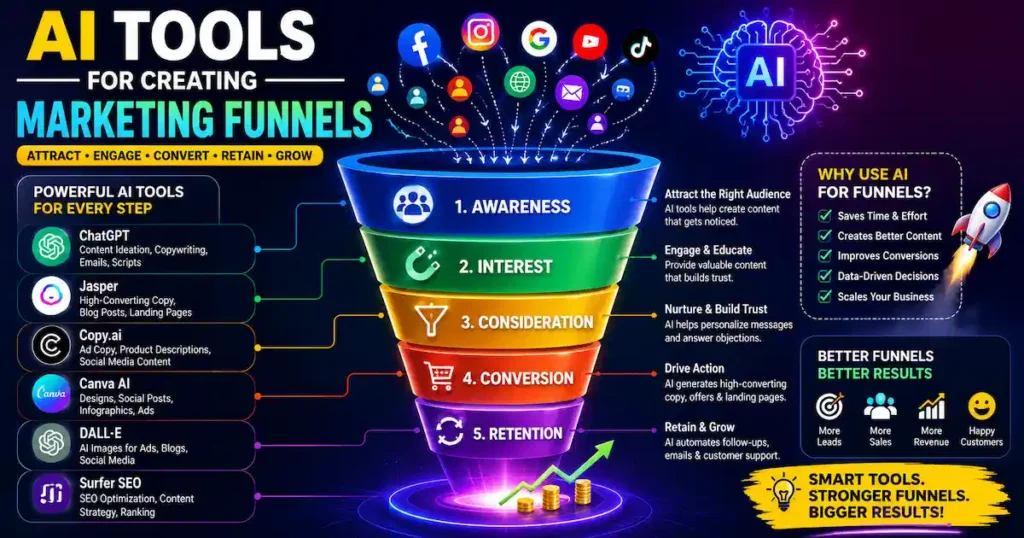
A marketing funnel is the path a stranger takes to become a paying customer. It starts with awareness (they find you), moves through consideration (they evaluate you), and ends at conversion (they buy from you).
An AI-powered marketing funnel layers machine learning and automation into every stage of that journey. AI can optimize marketing funnel Instead of manually writing every email or guessing which landing page headline performs better, the AI handles the heavy lifting — testing, personalizing, and optimizing as it learns.
Why This Is Different From Old-School Automation
Old automation tools were rule-based. You’d set up a trigger: “if someone clicks this link, send this email.” Useful, but static.
AI funnel tools are dynamic. They analyze behavior patterns, predict which leads are most likely to convert, and adapt messaging in real time. HubSpot’s Breeze AI, for example, uses predictive lead scoring to rank prospects by conversion likelihood — so your sales team stops wasting time on cold leads.
📊 McKinsey estimates that generative AI could unlock between $0.8 trillion and $1.2 trillion in annual value across sales and marketing alone — McKinsey State of AI, 2025
That’s not a distant projection. Businesses building AI-driven funnels today are already seeing faster sales cycles, lower acquisition costs, and better retention.
Key Takeaway: An AI marketing funnel replaces guesswork with real-time intelligence — letting small teams compete at a level that used to require a full in-house marketing department.
How AI Marketing Funnel Tools Actually Work
Understanding what’s happening under the hood helps you use these tools far more effectively.
The 3 Core Functions
Most AI marketing funnel tools operate across three core functions:
1. Lead Generation and Qualification AI scans behavior signals — page visits, time on site, email opens, link clicks — and scores leads automatically. Tools like Apollo.io provide access to over 275 million verified contacts with built-in intent data, enabling you to target individuals who are already searching for what you sell.
2. Personalized Nurture Sequences Instead of blasting the same email to your entire list, AI segments by behavior and sends content that matches where each person is in the funnel. ActiveCampaign’s behavioral triggers, for instance, fire personalized sequences the moment a lead takes a specific action — not on a fixed timer.
3. Conversion Optimization AI runs continuous A/B tests on headlines, CTAs, form layouts, and pricing pages. It doesn’t wait for you to notice something is underperforming — it detects and fixes it automatically.
What Connects It All
The best AI funnel tools pull everything into a single dashboard: traffic data, lead scores, email engagement, conversion rates, and revenue attribution. This means you can see exactly where leads are dropping off and fix those gaps without digging through five different platforms.
💡 Pro Tip: Before you buy any AI funnel tool, map your current funnel on paper first. Identify which stage loses the most leads (awareness, consideration, or conversion). That tells you exactly which type of tool to prioritize.
Key Takeaway: AI funnel tools aren’t magic — they’re highly efficient systems that replace manual guesswork with behavioral data and automation. Understanding the three core functions helps you pick the right tool for the right job.
The 7 Best AI Marketing Funnel Tools Right Now
Here’s a curated comparison of the top AI marketing funnel tools available in 2026. All of these are real, currently active platforms with verified pricing. AI-marketing funnels improve conversion rates with personalized marketing messages and client communication tools.
These tools represent different strengths — all-in-one platforms, specialist funnel builders, and AI-first automation — so there’s an option for every budget and business type.
| Tool Best for Free Plan Starting | ing Price (USD / GBP) | Our Rating | ||
|---|---|---|---|---|
| HubSpot | All-in-one funnel + CRM | ✅ Yes | $20/mo / £16/mo | ⭐ 9.5/10 |
| ClickFunnels | Sales page funnels | ❌ No | $97/mo / £76/mo | ⭐ 8.5/10 |
| ActiveCampaign | Email automation & nurture | ❌ No (trial only) | $15/mo / £12/mo | ⭐ 9/10 |
| HighLevel | Agencies & small businesses | ❌ No (trial only) | $97/mo / £76/mo | ⭐ 9/10 |
| Jasper | AI copy for funnel content | ✅ Limited | $39/mo / £31/mo | ⭐ 8/10 |
| Apollo.io | Lead generation & outreach | ✅ Yes | $49/mo / £39/mo | ⭐ 8.5/10 |
| Systeme.io | Beginners & budget-conscious | ✅ Yes | $27/mo / £22/mo | ⭐ 8/10 |
Top pick for most users:
HubSpot if you want everything in one place; Systeme.io if you’re just starting out and want a capable free plan.
Key Takeaway
There’s no single “best” AI marketing funnel tool — the right one depends on your stage, budget, and whether you need a full CRM or a focused funnel builder.
How to Choose the Right AI Funnel Tool for Your Business
With dozens of options on the market, it’s easy to overspend on features you don’t need — or underspend on a tool that can’t scale with you.
Match the Tool to Your Funnel Stage
If you’re still building your audience, lead generation tools like Apollo.io matter more than conversion optimizers. If you’ve already got traffic but leads aren’t converting, a funnel builder like ClickFunnels or a behavioral email tool like ActiveCampaign is the better investment.
Consider Platform Availability in Your Market
Most tools listed above are fully available in the USA, UK, Canada, and Australia — but pricing and support can vary. In Australia, for example, GST adds roughly 10% to subscription costs, so factor that in when comparing monthly plans. UK users should check whether tools are GDPR-compliant (most major platforms are, but confirm before handing over customer data). Marketing funnel tools help e-commerce social media businesses attract visitors, nurture leads, and convert them into paying customers through automated and data-driven campaigns.
Think About Integration Before You Commit
The most powerful AI funnel setups don’t rely on one tool — they connect several. Before subscribing, check whether the platform integrates with your existing stack: your website builder, CRM, email provider, and payment gateway. HubSpot and HighLevel have the widest native integration libraries for small-to-mid-sized teams.
📌 Real Example: A freelance marketing consultant in Canada used HighLevel’s AI automation workflows — combining funnel pages, follow-up SMS sequences, and lead scoring — to increase her client conversion rate from 8% to 23% over three months. HighLevel’s published case studies document similar results across service-based businesses. (HighLevel Case Studies)
Key Takeaway: The best AI funnel tool for your business is the one that fits your current growth stage, integrates with your existing tools, and works within your regional compliance requirements.
3 Common Mistakes to Avoid When Using AI Funnel Tools
Most people buy an AI marketing tool expecting it to do everything automatically from day one. That’s how you waste three months of subscription fees.
Mistake 1: Skipping the Funnel Audit
If you feed broken logic into an AI system, you’ll get faster broken results. Before you automate anything, audit your current funnel manually. Identify where people drop off. If 60% of leads never open your welcome email, fixing that one step will outperform any AI optimization downstream.
Mistake 2: Over-Automating Too Early
Automation is most effective after you’ve validated your funnel manually. Many small business owners in the USA try to automate every stage before they know which messages actually convert. Start with one automated sequence — your welcome or onboarding flow — and validate it before layering in more AI.
Mistake 3: Ignoring Mobile Optimization
Over half of marketing funnel traffic comes from mobile devices. If your AI tool builds landing pages that look great on desktop but break on a phone, your conversion data is worthless. Always test on mobile before going live and choose tools with mobile-first templates (ClickFunnels and Systeme.io both handle this well).
Pro Tip:
Set up a simple KPI dashboard before you launch any automated funnel — track at minimum: open rate, click-through rate, cost per lead, and conversion rate. This gives you a baseline to measure AI improvements against.
Key Takeaway
AI funnel tools amplify what you already have — if the foundation is flawed, automation makes it fail faster. Audit first, automate second.
How to Build Your First AI Marketing Funnel in 5 Steps
You don’t need a development team or a $500/month software stack to get started. Here’s a lean, practical approach that works for freelancers and small business owners in the USA, UK, Canada, and Australia.
Step 1: Define Your Offer and Ideal Buyer
Nail down exactly what you’re selling and who needs it most. If you skip this, no AI tool in the world will save your funnel. Write one sentence: “I help [specific person] achieve [specific result] without [specific pain point].”
Step 2: Choose Your Funnel Type
Lead magnet funnel (most common for service businesses), product launch funnel, webinar funnel, or e-commerce funnel. Each has a different structure. Match the funnel type to your goal before choosing software.
Step 3: Build Your Core Pages
You need at minimum: a landing page, a thank-you page, and an email sequence. Use your chosen AI tool’s templates — ClickFunnels has 44+ pre-built funnel templates, and Systeme.io’s free plan includes full funnel-building capability.
Step 4: Set Up Your AI Automation Sequences
Configure your lead scoring (if available), your behavioral email triggers, and your follow-up sequences. Start with 3 to 5 emails. Keep early emails value-focused; don’t pitch until email 3 or later.
Step 5: Launch, Measure, and Optimize
Go live with your funnel, let it run for at least two weeks, then review your KPI dashboard. Look at where people drop off and test one change at a time. AI tools like HubSpot’s Breeze AI will surface optimization suggestions automatically — but you still need to make the final call.
Key Takeaway: Building an AI marketing funnel isn’t about having the fanciest tools — it’s about having a clear offer, a logical flow, and the discipline to test and improve rather than set and forget.
Frequently Asked Questions
AI marketing funnel tools are software platforms that use machine learning and automation to manage the stages of a customer journey — from lead generation through to conversion and retention. They can personalize messaging, score leads, run A/B tests, and trigger follow-up sequences without manual input.
AI analyzes behavioral data — what pages people visit, how long they spend, what emails they open — and uses that to serve more relevant content at the right time. This level of personalization consistently outperforms static email sequences and generic landing pages. According to Forrester, companies using automation see a 25–30% increase in lead conversion rates.
HubSpot is the most comprehensive option for teams that want an all-in-one CRM and funnel builder with strong AI features. For simpler setups, Systeme.io offers a capable free plan that handles full funnel building, email automation, and product delivery.
Yes — platforms like Systeme.io and ClickFunnels are specifically designed for non-technical users. They provide drag-and-drop builders, pre-made funnel templates, and guided setup workflows. Most offer free trials, so you can test before committing financially.
Pricing ranges from free (Systeme.io, HubSpot's free tier) to $15–$97/month for entry-level paid plans (roughly £12–£76/month for UK users). Enterprise platforms like Salesforce or full-stack HighLevel agency setups can run significantly higher. Most small business owners find a solid funnel setup for under $100/month.
Most leading AI funnel tools integrate with major email platforms, including Mailchimp, ActiveCampaign, Klaviyo, and ConvertKit. HubSpot and HighLevel have the most native integrations. Always check the integrations page before committing.
Systeme.io is the most freelancer-friendly — the free plan includes funnel building, email automation, and digital product delivery with no monthly fee. For freelancers who need lead-generation on-top-of-funnel tools, combining Apollo.io's free tier with Systeme.io covers most use cases at minimal cost.
Most major platforms (HubSpot, ActiveCampaign, HighLevel, Systeme.io) offer GDPR-compliant settings, including consent management and data processing agreements. Always enable GDPR settings within the platform and verify the tool's Data Processing Agreement (DPA) before collecting UK or EU customer data.
Most businesses see meaningful data within 2 to 4 weeks of launching a funnel — enough to identify drop-off points and make initial optimizations. Significant ROI improvements typically take 2 to 3 months, once the AI has enough behavioral data to optimize effectively.
Manual funnel management doesn't scale. As your lead volume grows, personally writing, segmenting, and optimizing every sequence becomes impossible. AI tools reduce content production time by up to 80% (SalesGroup AI, 2025) and continuously optimize based on real data — something no manual process can match at volume.
Final Thoughts
The core message across this guide is simple: AI marketing funnel tools work best when you pair them with a clear strategy and a validated offer. The tools that stand out — HubSpot, HighLevel, ActiveCampaign, and Systeme.io — each have distinct strengths, but they share one thing: they give small teams the ability to execute at a scale that once required a full marketing department. Choosing the right tool means matching your current growth stage, budget, and technical comfort level to what’s available.
The market isn’t slowing down. With AI marketing tools spending projected to reach over $107 billion by 2028, the gap between businesses using these tools and those that aren’t will only widen. Pick one tool, build one funnel, and start collecting data. That’s how the best marketers in the USA, UK, Canada, and Australia are winning right now — not by waiting for the perfect setup, but by moving first and optimizing along the way.