The Futuristics, right AI solutions for marketing can pay for themselves quickly. The wrong ones just add another subscription to your card statement. Most marketers already own at least one AI tool, but few have picked the ones that move revenue.
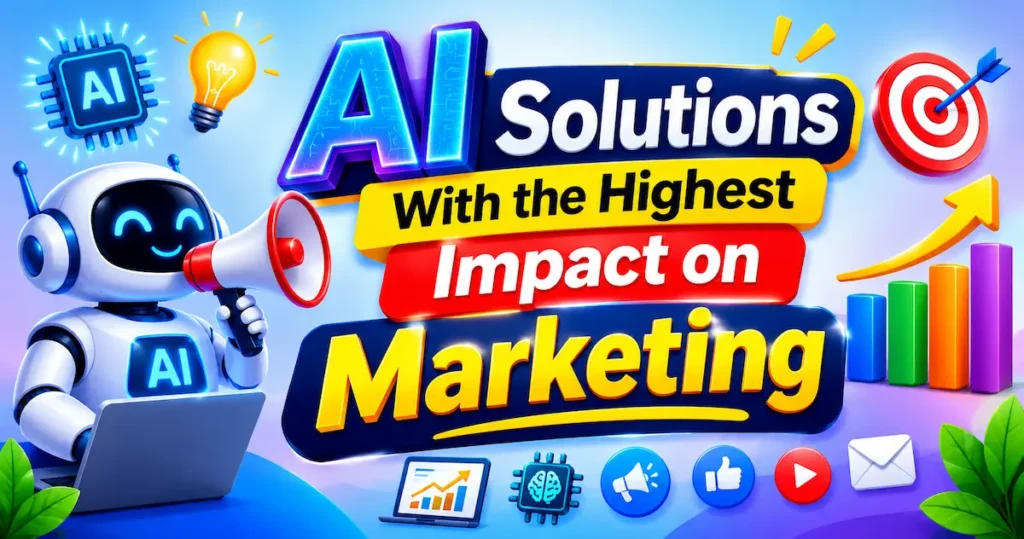
This guide ranks the five AI solutions with the highest impact on marketing results. You’ll see what each one does, which tools lead the pack, what they cost in USD and GBP, and a simple way to start. Whether you freelance, run a small shop, or manage client campaigns, you’ll leave with a shortlist you can act on today.
First, let’s agree on what “highest impact” actually means.
How to Judge AI Solutions for Marketing by Real Impact
Impact isn’t how slick a demo looks. It’s whether a tool saves hours, lifts revenue, or does both, and whether you can set it up without a developer. That’s why AI marketing automation works so well: it removes repetitive work and leaves you with the decisions.
Use these three filters before you pay for anything.
Time Saved
Start with the hours. If a tool cuts a weekly task from 2.5 hours to 20 minutes, you get back more than 100 hours a year. Drafting and reporting usually win here.
Revenue Influenced
Next, look for a direct line to money. Email, ads, and lead follow-up sit close to the sale, so improvements show up in your numbers quickly. Tools that only polish things nobody measures rarely pass this test.
Ease of Adoption
Finally, check the setup. As a beginner, you want a free plan or trial, ready-made templates, and integrations with apps you already use. If a tool needs a week of configuration, it isn’t your first pick.
Want the bigger picture first? Our breakdown of AI email automation trends in 2026 shows where the market is heading.
Key Takeaway: The highest-impact AI tools earn their place on all three filters: hours saved, revenue influenced, and ease of setup.
5 AI Solutions for Marketing That Deliver the Biggest Payoff
These five are ranked by how quickly most beginners see a return. Each one maps to a task you’re probably already doing by hand.
1. AI Content Drafting and Repurposing
Content is where most marketers start, and for good reason. Tools like ChatGPT and Jasper turn a rough brief into a first draft in minutes.
The real win is repurposing. Turn one blog post into email copy, social posts, and ad variations. You still edit for voice and facts, but the blank page disappears.
2. AI Email and Lifecycle Personalisation
Email remains one of the most dependable revenue channels. Platforms like Klaviyo and HubSpot use customer behaviour to tailor subject lines, send times, and product recommendations.
Our guide to AI email personalisation at scale walks through setup. For realistic targets, check these AI email automation ROI benchmarks.
3. AI Workflow Automation
Automation tools connect your apps so leads, follow-ups, and reports move without you. A new form submission can trigger a CRM entry, a welcome email, and a Slack alert automatically.
Zapier is the easiest starting point, and our Make.com vs Zapier comparison helps you choose.
4. AI Design and Creative Production
Canva’s AI features handle background removal, resizing, and layout suggestions. A freelancer can produce a week of social graphics in one afternoon.
This matters most for small businesses without a designer. Consistent visuals build trust faster than occasional perfect ones.
5. AI Analytics and Reporting
Upload a campaign export to ChatGPT and ask which channels drive leads and why. Platforms like HubSpot also offer built-in reporting.
A monthly report that once ate two hours can shrink to minutes. You spend that time acting on the insights instead.
💡 Pro Tip: Take your best-performing blog post today, paste it into ChatGPT, and ask for five email subject lines and three social posts in your brand voice.
Key Takeaway: Start with the solution closest to your revenue, usually email or content, then add automation once it works.
6 Best AI Marketing Tools Compared: Pricing in USD and GBP
Here’s how six proven AI marketing tools for small business owners and freelancers compare. Prices were checked in November 2026, and GBP figures are approximate conversions.
1. ChatGPT
Best For: Drafting, analysis, and brainstorming.
Free Plan: Yes.
Starting Price: $20 / approximately £15 per month (Plus).
Our Rating: ⭐ 4.7/5
2. Jasper
Best For: Brand-voice content creation for marketing teams.
Free Plan: No (7-day trial).
Starting Price: $59 / approximately £45 per month (annual billing).
Our Rating: ⭐ 4.0/5
3. Canva
Best For: Social media graphics, advertisements, and visual design.
Free Plan: Yes.
Starting Price: Approximately $15–18 / £13 per month (Pro).
Our Rating: ⭐ 4.6/5
4. Klaviyo
Best For: Email and SMS personalisation.
Free Plan: Yes (250 profiles).
Starting Price: $20 / approximately £15 per month.
Our Rating: ⭐ 4.5/5
5. HubSpot
Best For: CRM and marketing management.
Free Plan: Yes (free tools).
Starting Price: Approximately $15–20 / £12–15 per seat.
Our Rating: ⭐ 4.4/5
6. Zapier
Best For: Workflow automation and connecting marketing apps.
Free Plan: Yes (100 tasks).
- Starting Price: $19.99 / approximately £15 per month (annual billing).
If you’re starting from zero, pair ChatGPT’s free plan with Canva Free, then add Klaviyo or HubSpot once your email list grows.
Pricing also varies by market. Canva bills UK users in GBP, with Pro around £13 a month. Canadian marketers often pay in USD and absorb card foreign-exchange fees. Australian users should check Klaviyo’s dedicated Australian pricing page for local-currency rates.
In the USA, the list prices above are your baseline. In the UK and Canada, also confirm consent rules (UK GDPR and Canada’s CASL) before automating any email.
Key Takeaway: Begin with free plans, and only pay once a tool is clearly saving you time or earning you money.
Real Results: What AI Marketing Delivers in Practice
Adoption is no longer the advantage. Execution is.
📊 80% of marketers now use AI to create content — HubSpot State of Marketing, 2026
That means everyone has access to the same drafts. What separates winners is how they use AI on targeting and personalisation, not volume.
📌 Real Example: A software company’s marketing team in the USA used an AI-driven email personalisation system to lift conversion rates by 82% and open rates by 30%, according to its published case study.
Notice what they didn’t do. They didn’t send more emails. They sent more relevant ones.
You can copy that logic at small scale. Freelancers can start with our guide to AI email automation for coaches, consultants, and freelancers.
Key Takeaway: Results come from tailoring messages with AI, not simply producing more of them.
4 Mistakes That Waste Your AI Marketing Budget
Most failed AI rollouts share the same causes. Avoid these four, and you’re ahead of most teams.
Mistake 1: Buying Several Tools at Once
You can’t judge impact when everything changes together. Pick one workflow, test one tool, and measure.
Mistake 2: Publishing Raw AI Output
Unedited drafts sound generic, and readers notice. Always add your own examples, facts, and voice.
Mistake 3: Ignoring Consent and Data Rules
Personalisation relies on customer data. Check consent requirements in your market before you automate outreach.
Mistake 4: Skipping Measurement
Without a baseline, you can’t prove a tool works. Record your starting numbers first, such as hours spent or conversion rate.
Ready to build on this? Our roundup of the best AI tools to automate email follow-ups is a practical next step. If you’re comparing platforms, see Omnisend vs Mailchimp and ActiveCampaign vs HubSpot.
💡 Pro Tip: Set a 30-day review date in your calendar today, and track just one number, either hours saved or leads generated.
Key Takeaway: Use one tool, edit its output, respect consent rules, and measure from day one.
Frequently Asked Questions
They’re software tools that use machine learning or generative AI to handle tasks like writing, design, email personalisation, automation, and reporting. They save time and help you target customers more accurately.
For most small teams, AI email personalisation and AI content drafting deliver the fastest return. Both sit close to revenue and need little setup. Automation then multiplies those gains.
Many offer free plans. Paid plans commonly start around $15–$20 (£11–£15) per month, while Jasper starts at $59 (about £45) billed annually. Costs rise with contacts, seats, or task volume.
Yes. Most tools use templates, drag-and-drop editors, and plain-English prompts. You can run your first workflow in an afternoon.
It is when you focus on one workflow and measure the result. Track hours saved or revenue influenced for 30 days before expanding.
Pick one repetitive task, such as new-lead follow-up. Connect your form, CRM, and email tool with a platform like Zapier, then review results weekly.
Start with free plans of ChatGPT, Canva, and Zapier. Add Klaviyo or HubSpot when clients need email or CRM features.
No. Edit for accuracy, brand voice, and originality before publishing. AI drafts can contain errors or sound generic.
No. AI handles drafting and repetitive work well, but strategy, judgment, and customer relationships still need people.
Common causes are unclear goals, too many tools at once, unedited output, and no measurement. Fixing those four usually turns things around.
Final Thoughts
The best AI solutions for marketing share three traits: they save real hours, sit close to revenue, and are simple enough to adopt this week. Content drafting, email personalisation, and workflow automation are the strongest starting points. Your results will depend more on how you use a tool than on which one you pick.
Pick one workflow, run it for 30 days, and let your own numbers tell you what to scale next.