In futuristics, e-commerce brands use AI to improve marketing ROI by cutting wasted ad spend, personalizing every customer touchpoint, and automating decisions that used to take a full marketing team days to make. If you’re still manually building segments, guessing at ad creative, or sending the same email to your whole list, you’re leaving money on the table. This guide breaks down exactly which AI tactics move the needle, which tools are worth paying for, and how a real retailer used AI to grow campaign revenue without growing headcount. By the end, you’ll know precisely where to start and that’s where the real ROI conversation begins
Why AI Is Becoming Non-Negotiable for Ecommerce Marketing ROI
Marketing budgets aren’t growing the way they used to, but customer expectations are. Shoppers want relevant offers, fast answers, and product recommendations that actually make sense for them not a generic blast to your entire list. That’s a hard problem to solve manually once you have more than a few thousand customers.
For small teams especially, AI functions like a force multiplier. A two-person marketing team at a growing DTC brand in the USA can now run the kind of segmented, always-on campaigns that used to require a five-person department. That’s the real story behind ecommerce brands using AI to improve marketing ROI it’s not about flashy tech; it’s about doing more with the resources you already have.
There’s also a competitive dimension worth understanding. When one brand in a category starts using AI to personalize offers and sharpen targeting, competitors who stick with generic, one-size-fits-all campaigns don’t just fall behind gradually; the gap compounds. Every extra dollar of ad spend the AI-driven brand saves through better targeting gets reinvested into testing new creative or expanding into new channels, while the manual-process brand keeps burning budget on broad, untargeted reach.
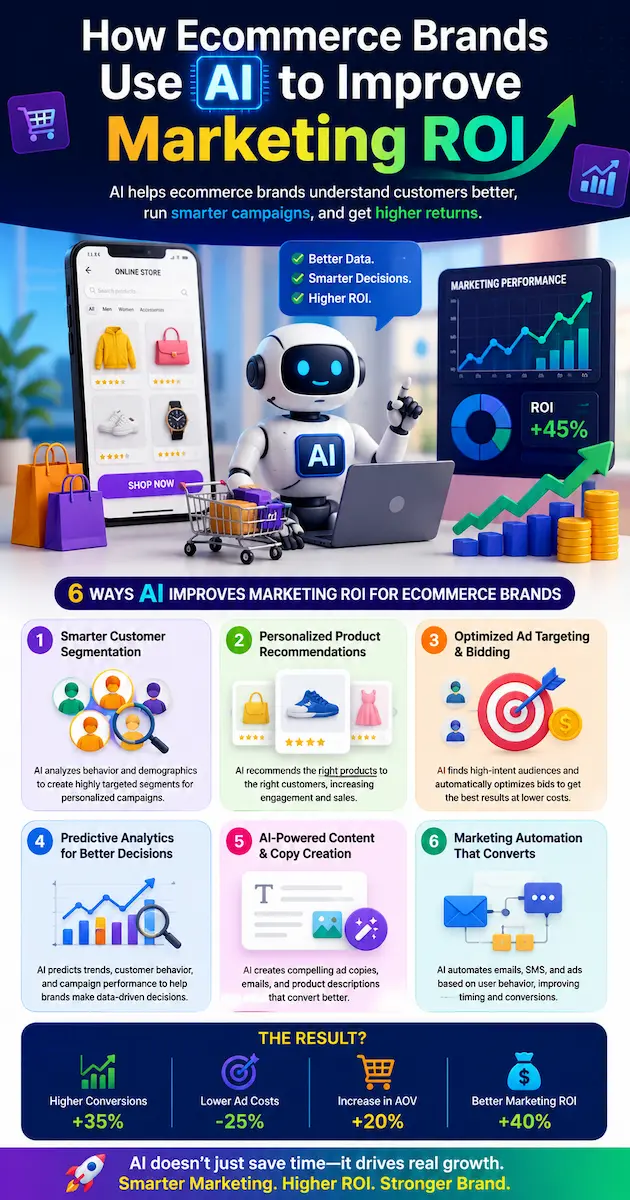
5 Ways Ecommerce Brands Use AI to Boost Marketing ROI
There isn’t one single “AI marketing hack.” Brands that see real returns usually stack several tactics together. Here are the five that consistently deliver.
1. Personalized Product Recommendations
AI recommendation engines analyze what a shopper viewed, added to cart, or purchased, then surface products they’re statistically likely to buy next. This shows up on product pages, in cart, and in post-purchase emails. It’s one of the fastest ways to lift average order value without discounting.
2. Dynamic Ad Audience Targeting
Instead of manually building lookalike audiences, AI tools continuously refine ad targeting based on real-time performance data, who’s clicking, who’s converting, and who’s just browsing. This reduces wasted spend on the wrong audience segments across Meta, Google, and TikTok ads.
3. Predictive Email and SMS Timing
AI models predict the exact time a specific customer is most likely to open an email or respond to a text, then send at that moment instead of a fixed blast time. Brands using send-time optimization typically see higher open and click-through rates than static scheduling.
4. AI-Generated Ad Creative and Copy Testing
Generative AI tools now produce and test dozens of ad variations, different headlines, images, and calls to action, automatically routing traffic toward whichever version converts best. This replaces weeks of manual A/B testing with a system that optimizes itself continuously.
5. Dynamic, Demand-Based Pricing
Some brands use AI to adjust pricing in real time based on demand, inventory levels, and competitor pricing. This is more common in the UK and Australia among mid-size retailers competing on marketplaces like Amazon, where pricing agility directly affects visibility and margin.
💡 Pro Tip: Start with just one of these five tactics. Product recommendations or send-time optimization are the easiest to implement and usually show ROI within the first month.
Key Takeaway: The highest-ROI AI tactics for ecommerce marketing are personalization, ad targeting, and send-time optimization start with whichever matches your biggest current bottleneck.
The Best AI Marketing Tools for Ecommerce Brands in 2026
Picking the right ai marketing tool depends on your platform, budget, and whether you need email, on-site personalization, or both. It’s easy to get overwhelmed by feature lists, so focus on one question first: where is your marketing ROI leaking the most right now? If it’s email engagement, start with a send and content optimization tool. If it’s on-site conversion, a recommendation engine will move the needle faster than anything else on this list.
For most freelancers and small business owners just getting started, Klaviyo or Omnisend offer the best entry point; both have usable free plans and integrate natively with Shopify, BigCommerce, and WooCommerce, so you’re not locked into a big contract before you’ve proven ROI.
Key Takeaway: Start with an AI tool that has a genuine free plan so you can prove ROI before committing budget to enterprise platforms.
Real Results: How One Retailer Used AI to Grow Campaign Revenue
📌 Real Example: A music and entertainment retailer in the UK used AI to group audiences and personalize ad targeting based on customer data, including purchase and engagement signals. The retailer achieved a 14% weekly increase in campaign revenue as a direct result of more precise, AI-driven ad audiences a level of targeting precision that wasn’t achievable with manual segmentation.
This matters because it wasn’t a massive budget increase that drove the lift it was better targeting of the same spend. That’s the pattern worth paying attention to AI’s biggest ROI wins usually come from efficiency, not additional investment.
Key Takeaway: The fastest AI-driven ROI wins typically come from smarter targeting of existing ad spend, not from spending more.
3 Mistakes That Quietly Kill AI Marketing ROI
Even good tools underperform when implementation goes wrong. Watch out for these three traps.
Mistake 1: Fragmented Customer Data
If your CRM, email platform, and store data don’t talk to each other, your AI tools are working with an incomplete picture. A customer who bought on desktop but browses on mobile should be recognized as the same person not treated like two different shoppers. This single issue is responsible for more disappointing AI results than any tool limitation. Before blaming the software, check whether it’s actually seeing your full customer history.
Mistake 2: Treating AI as “Set and Forget”
AI models need ongoing monitoring. A recommendation engine trained on holiday shopping behavior will misfire in February if nobody checks in. Budget time each month to review what the AI is actually recommending.
💡 Pro Tip: Block 30 minutes every Monday to review your AI tool’s top-performing segments and creative small course corrections compound over months.
Mistake 3: Skipping the Free Trial Test
Jumping straight to an enterprise contract before validating the tool on a smaller plan is one of the most common and expensive mistakes small business owners in Canada and Australia make when adopting these platforms. Most tools listed above offer a free plan or trial specifically so you can test before you commit.
Key Takeaway: Most AI marketing ROI failures come from poor data hygiene and lack of ongoing oversight, not from the tools themselves.
📊 Companies using AI to enhance customer experience see five to eight times the return on marketing spends compared to those that don’t. Netguru, 2026
How to Start Using AI in Your Ecommerce Marketing This Month
You don’t need to overhaul your entire stack to start seeing results, and you definitely don’t need to buy five new tools in the same month. The brands that stall out with AI marketing are almost always the ones that tried to do everything at once, got overwhelmed by conflicting data, and abandoned the effort within a few weeks. A slower, sequenced rollout consistently outperforms an all-at-once approach. Here’s a realistic starting sequence.
Week 1
Audit your current customer data. Make sure your email platform, store, and ad accounts are actually connected and sharing data properly. This is the unglamorous step everyone skips — and the one that determines whether AI tools work well or poorly.
Week 2
Turn on one AI feature inside a tool you already use. If you’re on Klaviyo or Omnisend, that’s usually predictive send-time optimization or an AI-generated product recommendation block. Don’t add new software yet.
Week 3
Test AI-generated ad creative on a small budget: $10–20 a day is enough to see directional results. Compare performance against your existing manual creative.
Week 4
Review the data. Keep what worked, cut what didn’t, and only then consider adding a second tool. Brands in the USA running lean marketing teams often see their clearest ROI signal within this first month, simply because they’re finally comparing AI-assisted campaigns against a real baseline.
Key Takeaway: A four-week phased rollout data audit, one feature, one small test, one review beats adopting five AI tools at once.
Frequently Asked Questions
Start with AI-powered email or SMS send-time optimization inside a tool you already use, like Klaviyo or Omnisend. It requires no new integration and typically shows measurable results within a few weeks.
Many tools, including Klaviyo, Omnisend, and LimeSpot, offer usable free plans, with paid tiers starting around $16–$20 per month (roughly £13–£16). Enterprise platforms like Constructor can run $50,000 or more per year.
No. Small and mid-size stores often see faster, more visible ROI because they're starting from manual processes, so the efficiency gain from automation is more dramatic relative to their existing baseline.
Yes, when it's used to sharpen audience targeting rather than simply increase reach. Brands that use AI to refine who sees their ads instead of showing ads to everyone typically cut wasted spend while maintaining or improving conversion volume.
LimeSpot and Klaviyo both offer native, low-code Shopify integrations, making them practical starting points for store owners without a developer on staff.
Usually, because of fragmented customer data, no ongoing monitoring, or jumping straight to an expensive enterprise plan before validating the tool works for their specific catalog and audience.
Yes. Tools like Klaviyo, Omnisend, and Nosto operate across the UK, Canada, and Australia, though pricing, currency, and some regional SMS features vary by market.
Product recommendation engines often show measurable lift within 30–60 days, while broader personalization strategies across email, ads, and on-site content typically take 3–6 months to fully mature.
Basic segmentation groups customers into static categories manually. AI personalization continuously adjusts in real time based on individual behavior, without a human rebuilding the segments.
Track marketing spend efficiency revenue generated per dollar spent rather than just conversion rate alone. It's the clearest signal of whether AI is improving ROI or simply shifting where conversions come from.
Final Thoughts
Ecommerce brands use AI v/s traditional marketing ROI by personalizing recommendations, sharpening ad targeting, and automating the send-time and creative decisions that used to eat up hours of manual work. The brands seeing the biggest gains aren’t necessarily spending more they’re spending the same budget more precisely, backed by real customer data instead of guesswork.
Start small, pick one tactic, and let the data guide your next move. The tools covered here are accessible to a freelancer or a five-person team just as much as an enterprise retailer the only real barrier left is deciding to start.