AI marketing vs traditional marketing ROI isn’t really a fair fight anymore — and the data backing that up might surprise you. Marketing teams using AI across their core functions report a 44% jump in output and ROI compared to teams that don’t, according to recent industry research. But before you fire your billboard guy or cancel your trade show booth, here’s the catch: traditional marketing still wins in specific situations AI hasn’t cracked yet.
In futuristics, this article breaks down exactly where each approach delivers real returns, what it actually costs in 2026, and which tools are worth your money right now. No hype, no “AI will replace everything” nonsense. Just the numbers and what to do with them.
Let’s start with why “ROI” means something different depending on which side of this debate you’re standing on.
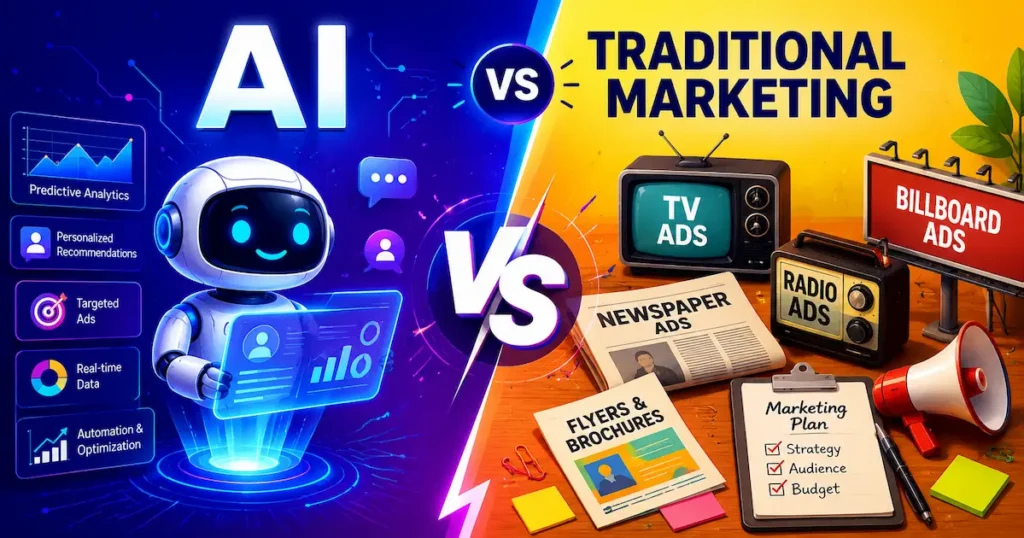
What "ROI" Actually Means in AI Marketing vs Traditional Marketing
Here’s the problem with most AI vs traditional marketing ROI comparisons: they’re comparing different things and calling it the same metric.
- Traditional marketing ROI is usually measured over months or years — brand recall, customer lifetime value, word-of-mouth referrals. A billboard campaign or a sponsored local event doesn’t convert next Tuesday. It builds trust slowly, and that trust eventually turns into sales.
- AI marketing ROI is measured in days or weeks. You can track exactly which ad variant converted, which email subject line got opened, and which landing page held attention longest. That’s a fundamentally different kind of return.
Why This Distinction Matters for Your Budget
If you’re a freelancer or small business owner trying to decide where to put next month’s marketing budget, this matters more than the headline stats. A figure like “AI delivers 22% higher ROI” sounds compelling, but it’s typically measured against fast, trackable conversions — not long-term brand equity.
Traditional channels still play a role in things AI struggles to measure cleanly: trust-building, local reputation, and high-ticket B2B relationships. The honest answer is that you need both metrics, not just one.
💡 Pro Tip: Before comparing any ROI numbers, write down what timeframe you’re actually measuring — 30 days, 90 days, or a full year. Comparing a 30-day AI campaign against a 12-month brand campaign will always make AI look better, even when it isn’t.
Key Takeaway: AI marketing ROI is fast and trackable; traditional marketing ROI is slow and trust-based — comparing them without matching timeframes leads to bad decisions.
Where Traditional Marketing Still Wins on ROI
AI hasn’t won every category, and pretending otherwise does your budget no favors.
Local and High-Trust Businesses
If you’re a dentist in Manchester, a plumber in Toronto, or a boutique law firm in Sydney, your customers are buying trust as much as a service. Local sponsorships, community events, and referral networks still convert at a higher rate than cold digital outreach in these categories — because the decision involves letting someone into your home or handling something sensitive.
Premium and Luxury Categories
High-end consumer goods and B2B enterprise sales still rely heavily on relationship-driven, traditional approaches. Personal events, print campaigns in trade publications, and face-to-face pitching remain stronger converters for big-ticket purchases where a single AI-generated email won’t close a $50,000 deal.
Emotional Brand Storytelling
A well-produced traditional TV spot or print campaign can build emotional resonance in ways that AI-assembled content frequently can’t yet replicate at the same craft level. This matters most for brand campaigns built around legacy, heritage, or cultural identity rather than immediate conversion.
The mistake most businesses make here isn’t using traditional marketing — it’s running it with zero feedback loop. Adding dedicated landing page URLs, call tracking numbers, or QR codes to a traditional campaign instantly makes its ROI measurable, which closes most of the “we can’t tell if this works” gap that gives AI marketing its reputation advantage.
Key Takeaway: Traditional marketing still delivers the best ROI for local trust-building, premium sales, and emotional brand storytelling — especially when paired with basic digital tracking.
Where AI Marketing Wins on ROI (And Why the Gap Is Growing)
📊 AI-driven campaigns deliver 22% higher ROI, 32% more conversions, and 29% lower customer acquisition costs than traditional methods — McKinsey, 2026.
Choose AI marketing tools that grow business and marketing leads.
Speed and Cost Per Asset
AI cuts the marginal cost of producing marketing content close to zero. A single AI workflow can generate dozens of social posts, ad variants, or email sequences in the time it takes a traditional team to produce a handful. Businesses report 40–60% reductions in content production costs as a direct result.
Personalization at Scale
AI can segment audiences into thousands of micro-groups and personalize messaging for each one — something a human team simply can’t do manually past a certain audience size. This is the single biggest reason AI-driven email and ad campaigns consistently outperform generic, one-size-fits-all traditional sends.
Real-Time Optimization
Traditional campaigns get analyzed after they end. AI campaigns adjust mid-flight — reallocating ad spend toward what’s converting in real time, not next quarter. Performance Max and similar AI-driven bidding systems have cut wasted ad spend by roughly 37% compared to manual bidding, with ad ROI increases of around 50% in the same comparisons.
📌 Real Example: A freelance marketing consultant in the USA used Jasper AI combined with automated ad bidding to manage a small e-commerce client’s campaign single-handedly, cutting content production time by half while increasing qualified leads — a result consistent with HubSpot’s documented case studies on solo marketers scaling output with AI content tools.
Key Takeaway: AI marketing wins decisively on speed, personalization at scale, and real-time optimization — the three levers that move ROI fastest for digital-first businesses.
7 AI Marketing Tools That Are Actually Worth Your Budget in 2026
Not every AI marketing tool justifies its price tag. These seven currently deliver measurable ROI for freelancers, small businesses, and marketing teams across the USA, UK, Canada, and Australia.
|
Tool
|
Best For
|
Google Performance Max
|
Starting Price (USD / GBP)
|
Our Rating
|
|---|---|---|---|---|
|
Jasper AI
|
AI content creation & brand voice
|
No (7-day trial)
|
$69 / £55 per month
|
4.5/5
|
|
HubSpot Marketing Hub
|
All-in-one inbound marketing + CRM
|
Yes (limited)
|
$20 / £16 per month
|
4.4/5
|
|
ActiveCampaign
|
Email automation for small teams
|
No (14-day trial)
|
$49 / £39 per month
|
4.3/5
|
|
Semrush
|
SEO and AI content optimization
|
No (7-day trial)
|
$139 / £110 per month
|
4.6/5
|
|
Mailchimp
|
Beginner-friendly email + AI tools
|
Yes (limited)
|
$13 / £10 per month
|
4.1/5
|
|
Surfer SEO
|
AI-assisted content optimization
|
No (trial only)
|
$89 / £70 per month
|
4.4/5
|
|
Canva (Magic Studio)
|
AI-powered design and ad creative
|
Yes (limited
|
$13 / £10 per month
|
$13 / £10 per month
|
For most freelancers and small business owners starting, HubSpot’s free tier, paired with Canva’s Magic Studio, covers content, design, and basic automation without spending a dollar — upgrade to Jasper or Semrush once you have consistent revenue to reinvest.
Picking Based on Team Size
Solo freelancers generally do better starting with Mailchimp or Canva — low cost, minimal learning curve. Teams of 3 or more benefit more from HubSpot or ActiveCampaign, where the automation handles work that would otherwise need a dedicated employee.
Picking Based on Channel Focus
If your growth depends on organic search, Semrush and Surfer SEO pay for themselves quickly through traffic gains. If you’re running paid ads and email primarily, ActiveCampaign and HubSpot give you tighter attribution data.
Key Takeaway: The right AI marketing tool depends on your team size and primary channel — there’s no single “best” option, only the best fit for your specific workflow.
The Hybrid Approach: Why "AI vs Traditional" Is the Wrong Question
The businesses winning in 2026 aren’t choosing a side. They’re running both, deliberately.
A hybrid model uses AI for scale, speed, and data-driven decisions — content production, ad optimization, segmentation — while keeping human judgment for strategy, brand voice, and high-stakes relationships. This isn’t a compromise position. It’s where the actual ROI ceiling sits right now.
3 Mistakes That Quietly Kill Marketing ROI (AI or Not)
Before you blame the channel, check whether one of these mistakes is actually responsible for your disappointing numbers.
Mistake 1: Measuring the Wrong Stage
Most ROI problems concentrate on one specific stage of the funnel rather than spreading evenly. If you’re not sure where yours is breaking down, you’re optimizing blind — and no tool, AI or traditional, fixes a problem you haven’t located.
Mistake 2: Running AI Without Enough Data
AI-driven optimization needs traffic and conversion volume to work properly. Below a certain threshold, machine learning models don’t have enough signal, and results become erratic rather than improved. Smaller businesses sometimes adopt AI tools, expecting instant gains, and get inconsistent results simply because their data volume isn’t there yet.
Mistake 3: Buying Capability You Can’t Operate
A sophisticated AI marketing stack that’s poorly configured will underperform a simple, well-run traditional campaign every time. Capability fit matters more than feature count. If your team can’t realistically maintain a tool’s setup, it won’t deliver ROI, no matter how powerful it is on paper.
Key Takeaway: Most ROI problems trace back to measurement gaps, insufficient data volume, or tool complexity — not to AI versus traditional marketing itself.
How to Calculate Your Own Marketing ROI Before You Switch Anything
Skip the industry-wide averages for a minute. Here’s how to find your actual number.
Start with this formula: (Revenue from marketing − Marketing cost) ÷ Marketing cost × 100. Run it separately for each channel — your AI-driven email campaign, your local sponsorship, your paid ads — rather than lumping everything into one blended figure.
Then compare timeframes honestly. A traditional campaign measured over 12 months should be compared against a 12-month AI campaign cost, not a 30-day snapshot. This single fix eliminates most of the misleading “AI is 5x better” claims floating around.
Finally, factor in your time. If a tool saves you 6 hours a week, multiply that by your hourly rate and add it to the return side of the equation — time saved is real ROI, even when it doesn’t show up as direct revenue.
Key Takeaway: Calculate ROI per channel, on matching timeframes, and include time saved — that’s the only way to know which approach genuinely works for your business.
Frequently Asked Questions
AI marketing ROI is typically measured in days or weeks through trackable conversions like clicks, opens, and sales. Traditional marketing ROI is measured over months or years through brand recall, trust, and customer lifetime value, making direct comparisons tricky without matching timeframes.
AI marketing tools typically range from $13 to $140 per month for small businesses, while traditional marketing — print ads, sponsorships, trade shows — often costs hundreds or thousands per campaign with less granular tracking. The exact comparison depends on your channel mix and team size.
For fast, trackable channels like email, paid ads, and content, AI marketing generally delivers stronger ROI for small businesses with limited budgets. For local trust-building and premium sales, traditional approaches still hold their ground.
AI tools can replace repetitive tasks like content drafting, ad variant testing, and basic segmentation, but strategic decisions, brand voice, and client relationships still benefit from human oversight. Most successful small businesses use AI to extend their team's capacity rather than eliminate it.
Mailchimp and Canva's Magic Studio offer the best entry-level ROI for freelancers due to free tiers and low learning curves. As revenue grows, Jasper AI and Semrush typically deliver stronger returns for content and SEO-focused freelancers.
AI campaigns underperform when there isn't enough traffic or conversion data for the algorithm to optimize effectively, or when the tool is poorly configured. Below a certain data threshold, AI-driven decisions become inconsistent rather than smarter.
Most major AI marketing tools — including HubSpot, Jasper, Semrush, and ActiveCampaign — are fully available in the UK, Canada, and Australia, often with local currency pricing and region-specific support. A small number of newer AI features roll out to the US market first before expanding internationally.
Most businesses see measurable results within 30 to 90 days, particularly in email automation and paid ad optimization. SEO-focused AI tools like Semrush or Surfer SEO typically take 3 to 6 months to show ranking and traffic improvements.
Yes — combining both is increasingly the standard approach in 2026, using AI for scale and speed while keeping traditional tactics for relationship-driven, high-trust sales. This hybrid model consistently outperforms relying on either approach exclusively.
E-commerce, SaaS, and digital services see the largest ROI gap in favor of AI marketing due to high data volume and trackable conversions. Local services, luxury goods, and complex B2B sales see a much smaller gap, with traditional tactics often holding their own.
Final Thoughts
The real answer to AI marketing Roi vs traditional marketing ROI isn’t “AI wins” or “traditional wins” — it’s that they win different battles. AI delivers faster, more trackable returns through speed, personalization, and real-time optimization, while traditional marketing still holds ground in trust-building, premium sales, and emotional brand connection. The businesses pulling ahead in 2026 aren’t picking a side; they’re matching each tactic to the job it actually does best.
Start by auditing where your current marketing budget is going, calculate ROI per channel using matching timeframes, and you’ll have a far clearer answer than any industry-wide statistic could give you.