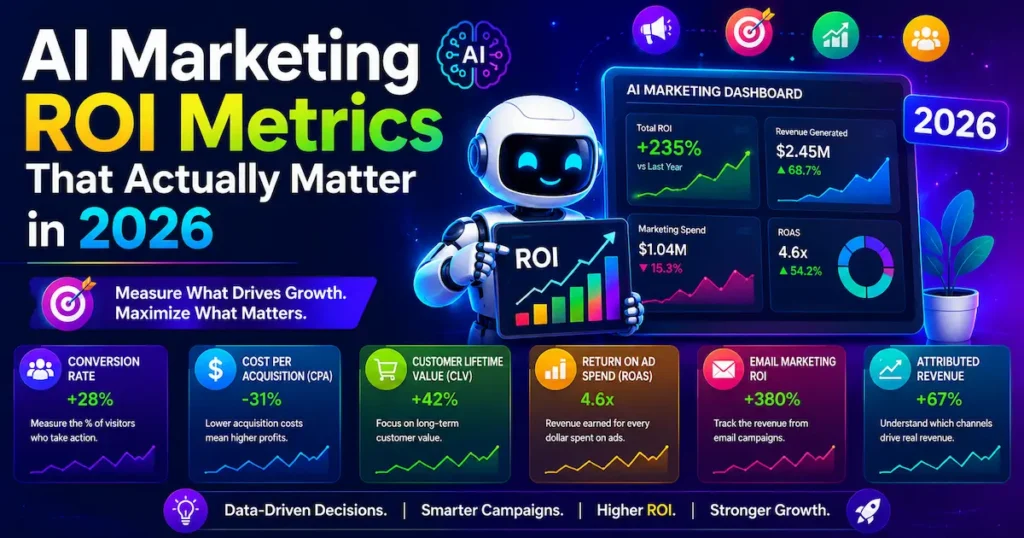
Most marketers tracking AI marketing roi metrics are measuring the wrong things — and wondering why their reports look great, but their results don’t. Vanity metrics like impressions and follower counts aren’t ROI. Neither is “engagement” if it doesn’t tie back to revenue.
The futuristics this guide cuts through the noise and shows you the specific metrics, tools, and tracking frameworks that actually tell you whether your AI-powered marketing is working. Whether you’re running paid ads in the USA, managing email funnels in the UK, or scaling a Shopify store in Australia, the principles here are the same. Let’s get into it.
Why Most Marketers Are Measuring AI ROI the Wrong Way
There’s a common trap. You adopt an AI tool, your output doubles, your team looks busy — and you assume that means positive ROI. It doesn’t.
Output volume is not ROI. Publishing more AI-generated content doesn’t mean you’re making more money. Sending more emails doesn’t mean you’re converting more customers. Without connecting those actions to revenue-driven marketing Roi kips, you’re flying blind.
The real problem is that most marketing teams set up tracking after launching AI tools — not before. By then, there’s no baseline to compare against, no control group, and no clean data.
What You Should Be Asking Instead
Before you add any AI tool to your stack, answer these three questions:
- What specific outcome is this tool supposed to improve?
- How will I measure that outcome before and after?
- What’s my acceptable cost per result?
These aren’t complicated questions. But most small business owners in Canada and Australia skip them entirely because the tool looks exciting, and it’s cheap to try. That excitement is expensive if you’re not measuring correctly.
According to McKinsey’s 2024 State of AI report, companies that formally measure AI’s business impact are 2.5x more likely to report significant revenue gains from AI adoption than those that don’t track it at all. — McKinsey & Company, 2024
Key Takeaway: ROI measurement must begin before you deploy AI tools — not after — or your data will always be inconclusive. ROI marketing software helps businesses track campaign performance, monitor ad spend, and measure returns accurately. It highlights key features that improve budget allocation and marketing decision-making.
The Core AI Marketing ROI Metrics That Actually Move the Needle
Not all metrics are equal. Here are the ones that genuinely reflect whether your AI marketing efforts are generating returns.
Cost Per Acquisition (CPA)
CPA is the cleanest signal. It tells you exactly how much you’re spending to win one customer. If AI tools reduce your CPA by automating ad copy testing, email personalization, or landing page variants — that’s measurable ROI.
Track CPA before and after introducing AI. If it drops, the tool is working. If it stays the same or rises, something is off with your setup or targeting.
Customer Lifetime Value (CLV) Uplift
AI-driven personalization — product recommendations, dynamic email content, predictive segmentation — is designed to increase CLV. But most marketers never check whether it actually did.
Segment customers who received AI-personalized experiences versus those who didn’t. Compare their average order value, purchase frequency, and churn rate over 90 days.
Revenue Per Campaign
This is your AI performance marketing metrics north star. Every campaign should have a projected revenue target. AI tools that help you hit or beat that target are delivering ROI. Ones that don’t — regardless of how “smart” they seem — aren’t.
Time-to-Revenue
AI is supposed to speed things up. If your team used to take 3 weeks to launch a campaign and now it takes 5 days, that’s a compressible cost with direct ROI implications. Track hours saved × hourly cost and compare against the AI tool’s monthly subscription.
💡 Pro Tip: Use a simple spreadsheet to log your pre-AI baseline metrics for CPA, CLV, and campaign launch time before you adopt any new tool. Future-you will thank present-you.
Key Takeaway: CPA, CLV uplift, revenue per campaign, and time-to-revenue are the four metrics that turn AI adoption from a cost into a measurable investment.
5 AI-Powered Tools That Make ROI Tracking Effortless
Tracking Roi tracking for campaigns manually is tedious and error prone. These tools automate the heavy lifting.
Here’s a comparison of tools that genuinely help with AI-driven campaign ROI tracking in 2025:
| Tool | Best For | Free Plan | Starting Price (USD / GBP) | Our Rating |
|---|---|---|---|---|
| HubSpot | Full-funnel ROI tracking + CRM | Yes (limited) | $20/mo / £16/mo | ⭐ 4.8/5 |
| Northbeam | multi-touch attribution for paid media | No | $99/mo / £79/mo | ⭐ 4.6/5 |
| Triple Whale | Shopify/DTC AI attribution | No | $129/mo / £103/mo | ⭐ 4.5/5 |
| Ruler Analytics | B2B revenue attribution | No | $199/mo / £159/mo | ⭐ 4.4/5 |
| Google Analytics 4 | Free baseline campaign tracking | Yes (full) | Free / Free | ⭐ 4.2/5 |
| Adalysis | AI-powered Google Ads ROI analysis | No | $99/mo / £79/mo | ⭐ 4.3/5 |
For most freelancers and small business owners just getting started, HubSpot + Google Analytics 4 is the right combination — free baseline tracking with CRM-level attribution when you’re ready to invest.
Key Takeaway: You don’t need an enterprise stack to track AI marketing ROI — the right two-tool combination can give you 80% of the visibility at a fraction of the cost.
How to Build a Simple ROI Tracking Framework for AI Campaigns
You don’t need a data analyst or a six-figure analytics platform. Here’s a practical framework any small business or freelancer can implement in a day.
Step 1: Define One Primary Metric Per Campaign
Every campaign should have one north-star metric. Not five. One. Examples:
- Email campaign → revenue per send
- Paid ad campaign → cost per lead
- Content campaign → organic revenue influenced
AI tools generate a lot of data. Without a single primary metric, you’ll get lost in it.
Step 2: Set a Baseline Before You Launch
Pull your last 30 days of data for that metric. Write it down. This is your “before AI” number. Without it, you can’t prove anything.
Step 3: Run a 30-Day Test Period
Launch your AI-powered campaign. Keep all other variables as consistent as possible — same audience, same offer, similar timing. Change only what the AI is improving.
Step 4: Compare and Calculate
At the 30-day mark, compare your primary metric against the baseline. Then calculate:
Simple ROI Formula: ROI (%) = ((Revenue Generated − AI Tool Cost) / AI Tool Cost) × 100
If you spent $200/month on an AI copy tool and it helped generate $1,400 in new revenue, your ROI is 600%. That’s a number worth reporting.
Step 5: Document and Scale
If the result is positive, document what worked — the prompt strategy, the audience segment, the offer — and replicate it. If it’s negative, kill it fast. Don’t wait three months hoping it improves.
 Pro Tip: Set a monthly “AI ROI Review” calendar reminder. Spend 20 minutes reviewing tool performance against your primary metrics. Cancel any tool that can’t demonstrate a positive ROI within 90 days.
Key Takeaway: A five-step tracking framework — define, baseline, test, calculate, document — lets any marketer prove or disprove AI ROI without a data team.
3 Marketing ROI KPIs You're Probably Ignoring
Everyone tracks conversions and revenue. But these three marketing roi kpis are often overlooked — and they can make the difference between a good AI strategy and a great one.
1. AI Content Attribution Rate
When AI-generated content assists in a conversion — through a blog post, email sequence, or ad copy — does your analytics platform credit it? Most don’t by default. Set up assisted conversion tracking in GA4 or HubSpot to see how much of your revenue chain AI content is actually touching.
2. Churn Rate by Segment
If you’re using AI for customer retention — personalized re-engagement emails, predictive churn alerts — then churn rate by customer segment is your KPI. A 5% drop in churn for your highest-value segment can be worth more than any top-of-funnel optimization.
3. Marketing Efficiency Ratio (MER)
MER = Total Revenue ÷ Total Marketing Spend. It’s a blunt instrument, but it’s incredibly useful for small teams in the UK and Canada who are scaling across multiple channels. If your MER improves when you add AI tools to your workflow, that’s the simplest proof of ROI there is.
📌 Real Example: A UK-based eCommerce brand selling sustainable apparel used Triple Whale to consolidate their AI-powered ad attribution across Meta and Google. Within 8 weeks, they identified that their Google Shopping campaigns were undervalued by their previous last-click model — reallocated budget accordingly — and reduced blended CPA by 34% without increasing total ad spend. Their MER improved from 3.1x to 4.4x.
Key Takeaway: Attribution rate, churn by segment, and Marketing Efficiency Ratio are three underused KPIs that often reveal the clearest picture of AI marketing ROI.
Real-World Results: What AI ROI Looks Like in Practice
Understanding AI marketing ROI metrics in theory is one thing. Seeing what the numbers actually look like for real businesses — freelancers, agencies, and small brands — is another.
What Freelancers See
A freelance digital marketer in Canada using AI tools like Jasper for ad copy and ChatGPT for campaign briefs can typically cut production time by 40–60%. If their hourly rate is $75 CAD, saving 10 hours per client project is $750 in recovered time. At $49/month for AI tooling, the ROI math is easy.
What Small Businesses See
A small eCommerce store in Australia running Google Shopping ads implemented AI-powered bid management via a tool like Optmyzr. Over 60 days, automated bidding reduced wasted spend by 22% and increased ROAS from 3.2x to 4.8x — without changing the product catalogue or pricing.
What Agencies See
A performance marketing agency in the USA running client campaigns across 15+ accounts used AI to automate weekly reporting and anomaly detection. Time saved per account: approximately 3 hours/week. At scale, that’s 45 hours/week — over $6,700/month in billable time reclaimed or redirected to strategy.
The pattern is consistent: AI ROI is clearest when you have a baseline, a defined metric, and a comparison period. Without those three things, even great results look like noise.
Key Takeaway: Across freelancers, small businesses, and agencies, AI marketing ROI is real and measurable — but only when the tracking infrastructure exists before the tools are deployed.
Frequently Asked Questions
The most important AI marketing roi metrics are Cost Per Acquisition (CPA), Customer Lifetime Value (CLV), Revenue Per Campaign, and Time-to-Revenue. These four connect directly to business outcomes rather than vanity statistics. Track them before and after AI adoption to get a clean comparison.
Use this formula: ROI (%) = ((Revenue Generated − Tool Cost) / Tool Cost) × 100. For example, if a $200/month AI tool contributes to $1,200 in revenue, your ROI is 500%. Include time savings in your calculation by multiplying hours saved by your hourly rate or team cost.
There's no single industry benchmark, but most marketing teams aim for a minimum 3:1 return — meaning $3 in revenue for every $1 spent on tools and campaigns. AI-assisted campaigns in mature channels like email typically see higher ROI (5:1 to 10:1) than experimental channels.
The core principles are the same — you're still measuring spend against revenue. The difference is that AI tools often affect multiple touchpoints simultaneously (copy, targeting, timing, personalization), so multi-touch attribution becomes more important than last-click models.
For beginners, Google Analytics 4 (free) paired with HubSpot Starter ($20/month) covers most needs. For eCommerce brands, Triple Whale and Northbeam offer deeper attribution. For B2B marketers, Ruler Analytics is purpose-built for revenue attribution across long sales cycles.
The KPIs themselves are universal — CPA, CLV, ROAS, and MER. However, benchmarks vary by market. CPA for paid ads in the UK and Australia is often higher than the USA due to smaller audience pools. Always compare your metrics against your own historical baseline rather than generic industry figures.
This usually means you're measuring output instead of outcomes. More content published, more emails sent, more ads created — these are output metrics. ROI only appears when you track whether those outputs led to conversions, revenue, or cost savings. Audit your metrics and connect them to business outcomes.
Most AI marketing tools should show measurable impact within 30 to 60 days if you have proper tracking in place. Tools focused on content production often show ROI faster (time savings are immediate). Tools focused on optimization — like AI bidding or predictive segmentation typically need 4–8 weeks of data to outperform manual methods.
Absolutely. The five-step framework in this article is designed specifically for lean teams. Google Analytics 4 is free, HubSpot has a free tier, and a basic spreadsheet handles the before/after comparison. The biggest barrier isn't tools — it's discipline in setting a baseline before launching anything new.
Start with Cost Per Acquisition. It's the clearest signal of whether your marketing spend is efficient, it's easy to calculate, and it ties directly to profitability. Once you have CPA under control, layer in CLV and Marketing Efficiency Ratio for a more complete picture.
Final Thoughts
Measuring AI marketing ROI doesn’t require a data science team or a six-figure analytics budget. It requires three things: a clear metric, a baseline before you start, and consistent tracking after. The tools covered here — from free options like GA4 to purpose-built platforms like Northbeam — make that process accessible to any freelancer, small business, or growing agency. The marketers winning with AI right now aren’t the ones with the most sophisticated stacks. They’re the ones who know exactly what they’re measuring and why.
Start with one campaign, one metric, and one 30-day test. That’s all it takes to move from guessing to knowing.