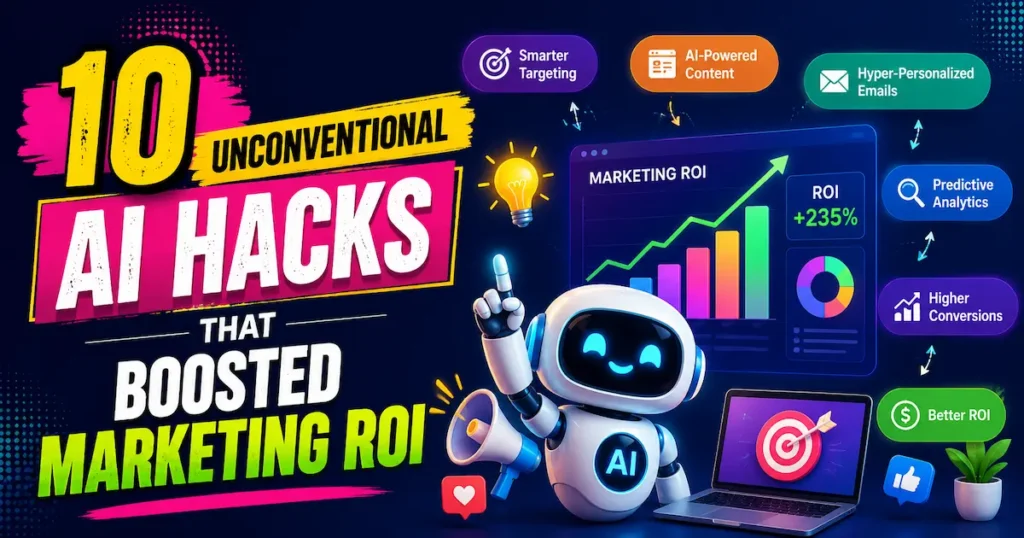
Most “AI marketing tips” articles tell you to write blog posts faster with ChatGPT. Helpful, sure. Groundbreaking, not really. In the futuristics, Unconventional AI marketing hacks that actually move ROI live somewhere else entirely in the weird, under-the-radar workflows that smart freelancers and small teams have quietly been running while everyone else fights over the same five prompts.
This isn’t a list of “use AI to write captions.” You already know that one. What follows are ten specific, slightly off-the-beaten-path tactics, the kind that save real hours and produce real revenue, not just busywork dressed up as productivity. Let’s get into the part everyone skips: the setup that makes these hacks work at all.
What Makes an AI Marketing Hack "Unconventional"
Every business now has access to the same handful of mainstream AI tools. ChatGPT for copy. Canva for design. HubSpot for email. So why do some marketers get 3x the results from identical software?
The difference isn’t the tool. It’s how it’s pointed.
- An unconventional hack usually does one of three things: it combines two tools in a way the vendors never intended, it automates a step nobody thought was automatable, or it uses AI for analysis instead of production. That last one matters more than people think — the companies seeing the biggest ROI lifts tend to be the ones investing in predictive capabilities, not just generative AI for content. Knowing what’s about to happen beats producing more content about what already happened.
- That mindset shift is the thread running through every hack below. None of them is about making more stuff. They’re about making smarter decisions, faster — and feeding those decisions back into the next campaign.
- It also explains why two businesses can run the same tool and get wildly different results. One treats AI as a faster typist. The other treats it as a faster analyst. The hacks below all lean toward the second category, because that’s where the actual margin lives.
- AI marketing vs traditional marketing is about data analysis, and personalisation can significantly boost campaign performance.
Key Takeaway: The biggest ROI gains come from using AI to predict and decide, not just to generate more content.
Unconventional AI Hacks for Smarter Targeting and Personalization
1. Turn Customer Support Chats into a Live Ad Targeting Feed
Most businesses treat support tickets and DMs as a cost center. Unconventional move: feed anonymized chat transcripts into an AI summarization tool weekly and pull out the exact phrases customers use to describe their problems. Then drop those phrases straight into ad headlines.
Best AI Tools for Digital Marketing ROI. This works because your customers are doing your market research for you, for free, in their own words that convert better than anything.
2. Use AI to Build “Negative Persanas” First
Before building who you’re targeting, ask an AI tool to help map who’s wasting your ad spend: people who click but never buy. Excluding that segment in platforms like Meta Ads or Google Ads often saves more budget than any targeting expansion does.
3. Run Micro-Surveys Through a Conversational AI Bot
Instead of a 20-question survey nobody finishes, a simple chat-based AI assistant on your site that asks 2–3 adaptive questions capture far higher response rates and the data feeds directly into segment-specific email flows.
💡 Pro Tip:
Set your AI chatbot to ask just one open-ended question after checkout (“What almost stopped you from buying today?”). The answers are gold for ad copy and objection-handling pages.
Key Takeaway: The richest targeting data is often already sitting in your support inbox and post-purchase moments. AI needs to be pointed at it.
Unconventional AI Hacks for Content That Actually Converts
1. Generate Dozens of Hook Variations, Not Full Drafts
The unconventional move here is restraint. Instead of asking AI to write a finished post, ask it for 30 different opening hooks for one piece of content, then have a human pick the strongest three to test. The smartest operators use AI to amplify content that’s already proven to convert, generating variations in hooks, angles, and visuals while letting analytics decide which patterns actually move traffic and sales rather than generating endless new content from scratch.
2. Build an “AI Visibility” Layer into Every Article
In 2026, buyers research inside AI chat tools before they ever hit a website. Structuring content with direct-answer sections under question-style headings increases the odds an AI engine cites you instead of a competitor. This is the GEO (Generative Engine Optimization) layer most small businesses still skip.
3. Repurpose One Asset Into Five Formats With a Single Prompt Chain
Take your best-performing blog post and run it through a prompt chain: summarize → turn into a LinkedIn carousel script → turn into 3 short-form video hooks → turn into an email subject line test. One piece of proven content, five distribution shots.
📌 Real Example: A freelance copywriter in the UK used this exact repurposing chain on a single case-study blog post and reported a 40% increase in qualified inbound leads over two months after distributing the repurposed formats across LinkedIn and email full breakdown documented on Marketer Milk.
Key Takeaway: Letting AI multiply your best content beats asking it to create more content from a blank page.
2 Unconventional AI Hacks for Automating the Boring (But Profitable) Stuff
Automate Competitor Price and Offer Tracking
Set up a no-code automation (Zapier or Gumloop both work well) to scrape competitor pricing pages weekly and summarize changes using AI. Marketers using this catch promotional windows and price-matching opportunities competitors assume nobody’s watching.
Let AI Pre-Qualify Leads Before a Human Touches Them
Route inbound leads through an AI agent that asks 3–4 qualifying questions before booking a call. This single change quietly fixes the most common complaint among solo marketers and freelancers: spending unpaid hours on calls that were never going to close.
💡 Pro Tip: Build your pre-qualification questions around budget, timeline, and decision-making authority the same three filters a junior sales rep would use, just running 24/7 without a salary.
Key Takeaway: The fastest ROI often comes from removing wasted hours, not adding new campaigns.
How to Measure If These Hacks Are Actually Working
This is where most marketers quietly fail. They run a hack for two weeks, don’t see a dramatic spike, and abandon it without ever measuring the right metric.
Vanity metrics like open rates or impressions don’t tell you if a hack worked. Revenue per email, cost per qualified lead, and time saved per week are the numbers that actually matter to your bottom line (or your client’s).
Set a 30-day test window for each hack. Track one input metric (time spent) and one output metric (leads, conversions, or revenue) before and after. If both move in the right direction, keep it. If only time saved improves, that’s still a win; just label it correctly instead of calling it an ROI hack.
This distinction matters more for freelancers and solo operators than anyone else, because every hour saved is an hour that can go toward billable client work or new business development. A hack that frees up four hours a week without touching revenue at all is still worth keeping, as long as you’re honest about what it’s actually doing for the business.
📊 Within well-structured AI marketing programs, 71% of marketing leaders who adopted AI tools report positive ROI within six months, with initial measurable results often appearing within just 30 to 60 days for use cases like email personalization and lead qualification, according to recent Gartner research.
Key Takeaway: Measure time saved and revenue impact separately both are valid wins, but only one is “ROI” in the strict sense.
Frequently Asked Questions
They're AI-powered tactics that go beyond standard content generation things like mining support chats for ad copy, automating competitor tracking, or using AI to pre-qualify leads before a human ever gets involved.
Businesses typically start by automating one repetitive task (like lead qualification or content repurposing) and reinvesting the time saved into strategy or outreach, rather than trying to overhaul their entire stack at once.
Yes, for most freelancers, it pays for itself within the first month through time saved alone, especially when used for content repurposing, lead routing, or client reporting.
Yes. Mining existing customer language from support tickets or surveys and feeding it into ad copy often improves click-through rates without increasing ad spend at all.
Claude and Zapier together cover the widest range of hacks on this list with the gentlest learning curve, since neither requires coding knowledge to get started.
Usually, because they're used for production (making more content) instead of decision-making (figuring out what to make, fix, or stop doing), the tool isn't the problem; the use case is.
Yes, several scales perform particularly well across clients, especially competitor tracking and lead pre-qualification, since both can be templated once and reused with minor adjustments per account.
Most freelancers and small teams see measurable time savings within the first two weeks, while revenue-impacting results (like improved lead quality) typically take 30 to 60 days to show clearly.
Pricing is largely consistent across all four markets, as most leading tools bill in USD, though UK and Australian users should factor in card conversion fees when budgeting for monthly costs.
Not if a human reviews outputs before publishing. The hacks in this list are designed to speed up research and production, not to entirely replace brand judgment.
Final Thoughts
The marketers getting outsized AI SEO Tools for ROI in 2026 aren’t using fancier tools; they’re pointing ordinary tools at unconventional jobs: mining support chats for ad copy, pre-qualifying leads automatically, and multiplying their best content instead of constantly making new content from scratch. The common thread across every one of these unconventional AI marketing hacks is using AI to decide and automate, not just to produce.
Pick one hack from this list, run it for 30 days, and measure it honestly. That’s how the marketers ahead of the curve got there, one tested workflow at a time, not one overnight overhaul.