
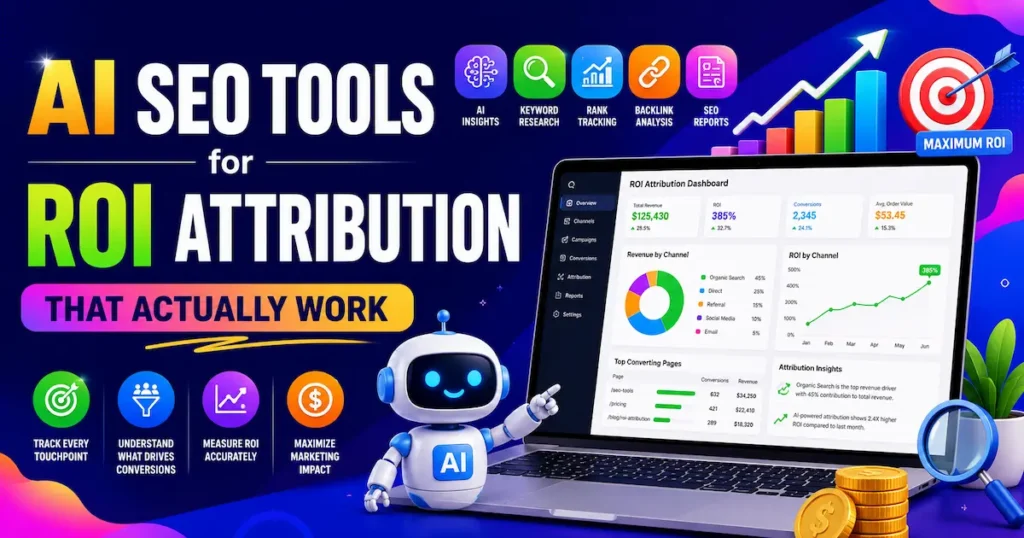
Most marketers running SEO campaigns still can’t answer the one question that matters most: “What did this actually earn us?” AI SEO tools for ROI attribution are finally closing that gap — connecting organic traffic to real revenue, not just rankings. In this article, you’ll learn how these tools work, which ones are worth your money in 2026, and how to set up attribution tracking that your clients, boss, or investors will actually understand. The futuristics, let’s get into it.
Why Most Marketers Can't Prove SEO ROI (And Why AI Changes That)
Ask ten marketers how they prove SEO value, and nine of them will point to a Google Analytics dashboard showing traffic spikes. That’s not ROI. That’s a vanity metric.
The real problem is attribution — knowing which content, which keyword, and which touchpoint actually drove a conversion or sale. Traditional analytics tools weren’t built for this. They use last-click attribution by default, meaning the final source before a purchase gets all the credit. Your three-month blog strategy that warmed up the lead? Invisible.
AI changes this in three meaningful ways:
AI Connects Multi-Touch Data Points
A user might find your brand through an organic blog post, leave, come back via a branded search, then convert through a paid ad. AI attribution tools can model that entire journey and assign weighted credit to each touchpoint — including your SEO work.
AI Finds Revenue Patterns Humans Miss
Traditional tools show you what happened. AI tools show you why it happened and what to do next. They surface correlations between content performance and pipeline revenue that would take a human analyst weeks to find manually.
AI Attribution Works at Scale
Freelancers and small agencies in the USA, UK, Canada, and Australia are managing dozens of clients simultaneously. AI-powered attribution doesn’t require a data science team — it runs automatically and delivers reports your clients can read in under five minutes.
Key Takeaway: Standard analytics shows traffic; AI attribution shows revenue — and that’s the difference between “SEO is working” and “SEO generated $47,000 this quarter.”
How AI SEO Tools Actually Measure ROI Attribution
Before you pick a tool, you need to understand how the measurement actually works. Otherwise, you’ll buy something expensive and never use it properly.
The Attribution Models AI Tools Use
Most AI SEO platforms support multiple attribution models and let the algorithm decide which fits your data best:
- First-touch: Full credit to the organic search that started the journey
- Last-touch: Credit to the final click before conversion (the default most tools use, and the least accurate for SEO)
- Linear: Equal credit split across all touchpoints
- Time-decay: More credit to touchpoints closer to conversion
- Data-driven (AI): The algorithm analyzes your actual conversion paths and assigns custom weightings — this is the most accurate model for SEO
Data-driven attribution is where AI earns its price tag. It adapts to your specific audience behavior rather than using a generic model that may not reflect your customers at all.
What Data Gets Pulled In
Good AI attribution tools connect to your:
- Google Search Console (organic click data)
- Google Analytics 4 or Adobe Analytics (behavior and conversions)
- CRM platforms like HubSpot or Salesforce (pipeline and revenue data)
- Ad platforms (so SEO gets credit it deserves relative to paid)
💡 Pro Tip: Connect your CRM before anything else. If your AI tool can’t see actual deal values or revenue, it can only measure “conversions” — not real ROI. The CRM integration is what turns a traffic report into a revenue report.
Key Takeaway: Data-driven attribution powered by AI marketing Roi is the only model that accurately reflects how SEO contributes to revenue across a multi-touch customer journey.
The 6 Best AI SEO Tools for ROI Attribution in 2026
Here’s a side-by-side look at the tools worth your time. These are all actively available in 2026 across the USA, UK, Australia, and Canada.
|
Tool
|
Best For
|
Google Performance Max
|
Starting Price (USD / GBP)
|
Our Rating
|
|---|---|---|---|---|
|
Full SEO + attribution suite
|
Limited
|
$139.95/mo / £110/mo
|
⭐ 4.8/5
|
|
|
CRM-connected revenue attribution
|
Yes (limited)
|
$800/mo / £635/mo
|
⭐ 4.6/5
|
|
|
Content ROI & organic traffic value
|
No
|
$129/mo / £102/mo
|
⭐ 4.5/5
|
|
|
Multi-channel attribution
|
No
|
$500/mo / £395/mo
|
⭐ 4.4/5
|
|
|
Agency-level SEO ROI reporting
|
No
|
Custom pricing
|
⭐ 4.3/5
|
|
|
Budget-friendly attribution setup
|
Yes (free)
|
Free / Free
|
⭐ 4.0/5
|
For freelancers and small businesses just starting out, the GA4 + Looker Studio combination is the best free entry point. Once revenue exceeds $10K/month from organic, upgrading to Semrush or Ahrefs gives you faster insights and better AI-powered recommendations.
Key Takeaway: Your budget and business size should drive your tool choice — but even a free GA4 setup, done properly, beats an expensive tool used wrong.
How to Set Up ROI Tracking with AI Tools in 3 Steps
Buying a tool is the easy part. Most small businesses and freelancers never configure it properly, which is why their reports still look useless six months later. Here’s the fast-track setup process.
Step 1: Define What “Conversion” Means (Before You Touch Any Tool)
This sounds obvious. Almost nobody does it. Before opening any dashboard, write down the exact actions that represent revenue to your business:
- A form submission that becomes a discovery call
- A product purchase over $100
- A subscription sign-up on a paid plan
Every tool will ask you to set up conversion goals. If you haven’t defined what matters, you’ll track everything — and learn nothing.
Step 2: Connect Your Data Sources
Link your AI attribution tool to:
- Google Search Console (required for organic data)
- Your CRM or e-commerce platform
- Any paid ad accounts (so you can compare SEO cost-per-acquisition against paid)
Most tools have native integrations that take under 30 minutes to set up. Rockerbox and HubSpot both walk you through this with guided setup wizards.
Step 3: Run a Baseline Report Before You Optimize Anything
Pull 90 days of data and establish your baseline numbers:
- Organic sessions → conversions rate
- Cost per organic lead (monthly SEO spend ÷ organic leads)
- Revenue attributed to organic (use data-driven model)
Now you have a starting point. Every optimization you make going forward can be measured against it.
📌 Real Example: A freelance digital marketer in Melbourne, Australia, used Semrush’s Attribution Report combined with HubSpot CRM data to discover that three blog posts — out of 47 published — were responsible for 68% of all organic leads. She cut her content production in half, doubled down on those three topics, and increased qualified leads by 41% in 90 days while reducing her workload.
Key Takeaway: Setup only takes a few hours, but defining your conversions before you start is the step that separates useful data from a confusing noise factory.
3 Common ROI Attribution Mistakes AI Helps You Avoid
SEO is a long game. Running attribution reports after 30 days and concluding “SEO doesn’t work” is like planting a seed and digging it up after a week. AI tools help here by projecting trajectory based on early signals — showing you whether the curve is heading in the right direction, even if the destination isn’t visible yet. Most AI platforms recommend a 90-day minimum reporting window before concluding.
Mistake 2: Counting Traffic as Revenue
High traffic means nothing if it doesn’t convert. A freelancer in the UK managing a local B2B client learned this after celebrating a 200% traffic increase — only for the client to discover that zero new leads came from organic. AI attribution tools would have flagged this immediately by showing a broken funnel between organic sessions and goal completions.
 Pro Tip: Set up a “micro-conversion” funnel inside your attribution tool. Track small wins — email sign-ups, content downloads, video plays — as intermediate steps. This gives you early proof of momentum before revenue shows up.
Mistake 3: Ignoring Assisted Conversions
According to Google’s own research, the average B2B buyer makes 12 searches before engaging with a brand’s website — meaning last-click attribution misses 11 of those 12 touchpoints. — Google/Millward Brown, 2024
When you only look at last-click, SEO looks like it does almost nothing. AI-powered, data-driven attribution reveals the full assisted-conversion picture — showing exactly how many deals SEO helped nurture, even when another channel got the final credit.
Key Takeaway: The three biggest attribution errors are all preventable with proper AI tool configuration and a 90-day minimum reporting window.
What ROI Numbers Should You Actually Expect from SEO?
Setting realistic expectations is part of measuring ROI correctly. Clients and business owners in Canada and the USA, in particular, tend to benchmark SEO against paid advertising, which is the wrong comparison.
SEO vs. Paid: The ROI Timeline Reality
Paid ads deliver returns immediately. SEO delivers return compoundingly. Here’s what that means in practice:
- Months 1–3: You’re investing. Don’t expect a positive ROI yet.
- Months 4–6: Early keyword wins start generating leads. ROI is typically break-even to slightly positive.
- Month 7–12: Compounding content and authority start delivering 3x–5x returns on monthly investment.
- Month 12+: Top-ranking content generates leads with zero incremental spend. This is where SEO ROI becomes exceptional.
AI attribution tools are particularly valuable in months 4–8, when results are emerging but aren’t yet obvious. They can detect early signals — improving click-through rates, longer time-on-page, content-to-CRM touchpoints — that tell you whether your trajectory is healthy before the big revenue numbers appear.
Industry Benchmarks to Know
For small businesses in the USA and UK, a healthy SEO ROI benchmark after 12 months is $3–$5 returned for every $1 invested in content and optimization. Agencies and freelancers managing SEO for SaaS companies or professional services firms in Australia and Canada often see ratios of 5:1 to 10:1 once content compounds.
These numbers mean nothing without proper attribution. An AI tool is how you prove you’re hitting — or beating — these benchmarks.
Key Takeaway: Expect SEO ROI to look slow for the first 90 days and accelerate sharply from month 6 onward — AI attribution tools are what make that acceleration visible and provable.
Frequently Asked Questions
AI SEO tools for ROI attribution are platforms that use machine learning to connect organic search activity — rankings, clicks, content engagement — to actual business outcomes like leads, sales, and revenue. They go beyond standard analytics by modeling multi-touch customer journeys and assigning weighted revenue credit to SEO efforts. Popular examples include Semrush, Ahrefs, and HubSpot Marketing Hub.
SEO ROI is calculated using the formula: (Revenue from Organic – Cost of SEO Investment) ÷ Cost of SEO Investment × 100. The tricky part is accurately attributing revenue to organic search rather than other channels. AI attribution tools handle this by modeling multi-touch journeys, so you're not guessing at which revenue came from SEO.
Yes, and Google Analytics 4 combined with Looker Studio is the best free option. You can connect Search Console data, set up conversion events, and build attribution reports at no cost. It requires more manual setup than paid tools, but for freelancers and small businesses just starting, it's a solid foundation before investing in paid platforms.
Semrush offers the best balance of AI-powered attribution features and usability for small businesses, starting at $139.95/month (approximately £110/month). If the budget is tight, GA4 plus Looker Studio is a free alternative that covers the basics effectively. HubSpot is the best choice if you already use their CRM, since the native integration makes revenue attribution much cleaner.
Absolutely. Local businesses benefit from AI attribution because it can tie organic local search traffic directly to phone calls, direction requests, and form submissions. Tools like Semrush Local and BrightLocal include AI-assisted reporting built specifically for local SEO performance, and both are available to users in the USA, UK, Canada, and Australia.
Standard analytics tools use simplified models — usually last-click — that ignore most of the customer journey. AI attribution uses data-driven modeling, which analyzes your actual historical conversion paths and assigns proportional credit to each touchpoint. This means your blog post that introduced a buyer to your brand six weeks before they converted actually gets the credit it deserves.
Yes. Most AI SEO attribution platforms support multi-client dashboards or workspace features. Semrush and Ahrefs both allow you to manage multiple projects under one account, making them practical for freelancers across the USA, UK, Canada, and Australia, managing anywhere from 3 to 30 clients simultaneously.
Most AI attribution tools need at least 90 days of data before their models become statistically reliable. With less data, the AI has too few conversion events to identify meaningful patterns. For new websites or campaigns, some tools provide projected ROI estimates based on early signals while the model trains on your actual data.
Start with Google Search Console, Google Analytics 4, and your CRM (HubSpot, Salesforce, or whatever you use). These three connections cover the majority of the customer journey data the AI needs. If you run paid campaigns, add Google Ads and Meta Ads to give the algorithm a complete picture so SEO gets appropriate credit relative to paid channels.
If you're spending more than $500/month on SEO services or content creation, an attribution tool quickly pays for itself by showing you what's working and what isn't — so you stop wasting budget on tactics that don't move the needle. For budgets under $500/month, start with free GA4 attribution and upgrade once your SEO investment grows.
Final Thoughts
Proving SEO ROI has always been the hardest part of the job — and it’s the reason so many clients cut their SEO budgets prematurely. Best AI tools for advertising ROI solve this by replacing guesswork with data-driven revenue modeling, connecting your organic content directly to the leads and sales it actually generates. The right tool, configured properly, will show you not just that SEO is working — but exactly how much it’s worth.
You don’t need a data science team or an enterprise budget to do this right. Start with a clear definition of what conversion means for your business, connect your core data sources, and give the model 90 days. The numbers will do the convincing for you.