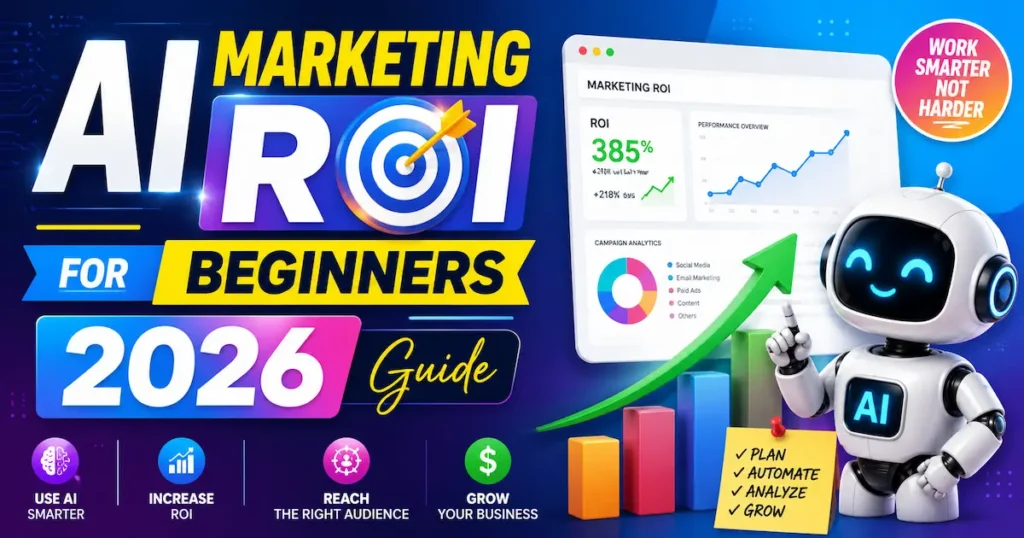
In Futuristics AI marketing ROI is the one number that separates people who are genuinely making money with AI from people who are just playing with chatbots. And right now, there’s a real gap between the two. Most freelancers and small business owners have tried ChatGPT or Jasper at least once but very few can tell you, in dollars, what it actually returned. This guide fixes that. By the end, you’ll know exactly how to calculate your AI marketing ROI, which tools are worth paying for in 2026, and which mistakes quietly drain your budget without you noticing. Let’s start with what this number actually means.
What AI Marketing ROI Actually Means
AI marketing ROI is simply the return you get in time saved, leads generated, or revenue earned compared to what you spent on AI tools and the hours it took to use them. It’s the same basic formula as traditional marketing ROI, but with one key difference: the “cost” side includes both subscription fees and your learning curve.
A lot of beginners skip this part. They sign up for a $49/month tool, use it for two weeks, get frustrated, and cancel without ever measuring whether it moved a single business metric.
Why AI ROI Is Harder to Track Than Traditional Marketing ROI
Traditional ROI is straightforward: you spend $500 on ads, you make $1,500 in sales, your ROI is 3x. AI tools blur this because their value often shows up indirectly as saved hours, faster content production, or better-targeted campaigns rather than a single traceable sale.
That’s why the smartest approach is tracking two types of ROI side by side: hard ROI (revenue, leads, sales) and soft ROI (hours saved, campaigns shipped faster, fewer errors).
📊 Small businesses that treat AI as core infrastructure not an experiment reports an average 3.7x return on their AI tool investment, according to McKinsey’s 2026 small business research.
Key Takeaway: AI marketing ROI strategy combines what you save in time with what you gain in revenue, so track both — not just one.
How to Calculate Your AI Marketing ROI in 5 Steps
You don’t need a finance degree to do this. You need five numbers and ten honest minutes.
Step 1–3: Gather Your Costs, Time, and Results
- Add up your AI tool costs for the month (subscriptions, credits, add-ons).
- Estimate your time cost. If a tool saves you 5 hours a week and your time is worth $40/hour, that’s $800/month in value even before revenue.
- Track the results directly tied to AI-assisted work leads from an AI-written email sequence, sales from an AI-optimized product page, or traffic from AI-assisted SEO content.
Step 4–5: Run the Formula and Review Monthly
The formula is: (Value gained – Cost of tools and time) ÷ Cost of tools and time × 100.
If you spent $60 on tools this month and generated $900 in extra sales plus $400 in time saved, your ROI is roughly 1,983%. Review this every month, not every day AI results compound, and daily swings will just stress you out.
💡 Pro Tip: Create one simple spreadsheet tab per tool, and log the specific outcome (a lead, a sale, a saved hour) every time you use it. After 30 days, you’ll have real data instead of a gut feeling.
Key Takeaway: Calculating AI marketing ROI takes five numbers — tool cost, time saved, and results reviewed monthly, not daily.
5 Ways AI Actually Improves Marketing ROI
It’s easy to assume AI just makes things faster. That’s true, but it’s not the whole story.
Faster Content, More Testing
When content takes 10 minutes instead of 2 hours, you can test five headlines instead of one. More tests mean faster discovery of what actually converts.
Smarter Targeting and Personalization
AI tools can segment audiences and personalize subject lines automatically, which is why AI-driven email campaigns regularly see higher open rates than generic blasts.
Predictive Lead Scoring
Instead of chasing every lead equally, AI tools flag which ones are most likely to buy so your limited time as a freelancer or small team goes where it actually pays off.
Real Example: A Chicago-based digital marketing agency, Intercore Technologies, used HubSpot’s AI-powered answer engine optimization tools to help a personal injury law client recover lost lead volume even though the firm already ranked #1 for its main keyword and had 15,000+ monthly organic visitors, as documented by HubSpot.
Reduced Ad Waste
AI-driven bid management in platforms like Google Performance Max can cut wasted ad spend significantly compared to manual bidding, which directly protects your ROI on paid campaigns.
Key Takeaway: AI improves ROI for beginners not just by saving time, but by helping you test more, target better, and waste less ad budget.
3 Mistakes That Quietly Kill Your AI Marketing ROI
Most beginners don’t fail because the tools are bad. They fail because of how the tools are used.
Mistake 1: Buying Tools Before Defining the Problem
Signing up for five AI tools because they looked useful, without a clear workflow, is the fastest way to waste a subscription budget. Pick the outcome first more leads, faster content, better email opens then choose the single tool built for that.
Mistake 2: Never Editing the Output
AI-generated content that goes out unedited tends to sound generic, and generic content converts worse than content with your actual voice in it. Always treat AI output as a first draft, not a final product.
Mistake 3: Not Tracking Anything
If you can’t say which leads, sales, or hours saved came from AI-assisted work, you can’t calculate ROI, and you’ll likely cancel a tool that was actually working.
Pro Tip: Before subscribing to any new AI tool, write down the one specific business metric you expect it to move. If you can’t name that metric, you’re not ready to buy it yet.
Key Takeaway: Most AI marketing ROI is lost through unclear goals, unedited output, and poor tracking, not bad tools.
How Much to Budget for AI Marketing Tools in 2026
Budgets vary a lot by market and business size. In the USA, most solo freelancers spend between $20–$100/month on a core AI stack, while small agencies in the UK and Canada typically budget £50–£300 (roughly $65–$390) as they add SEO and automation tools. In Australia, small business owners are increasingly bundling AI features already included in platforms like HubSpot or Canva rather than paying for standalone tools, which keeps costs lower.
A simple rule for beginners: start with one free or low-cost tool, prove ROI within 30 days using the formula from earlier in this guide, then reinvest a portion of what you saved or earned into the next tool. This staged approach avoids the most common beginner mistake: paying for a full AI stack before you’ve validated that any of it works for your specific business.
Key Takeaway: Start small, prove ROI in 30 days, then scale your AI budget with money the tools have already helped you earn or save.

Frequently Asked Questions
Anything above 100% (meaning the tool returned more than it cost, including your time) is a solid starting benchmark. Many small businesses report returns of 3x or higher once they move past the first month of testing.
Use the simple formula: (value gained minus cost) divided by cost, multiplied by 100. Track tool costs, hours saved, and any leads or sales tied to AI-assisted work in one spreadsheet.
For many freelancers and solo business owners, yes, ChatGPT alone can handle content drafts, email replies, and brainstorming. As you scale, adding a dedicated automation or SEO tool typically improves ROI further.
For basic content and email tasks, AI tools can replace some agency work. For strategy, complex campaigns, and paid ad management at scale, most businesses still benefit from human expertise guiding the AI.
HubSpot AI and ChatGPT together tend to deliver the fastest measurable ROI, since one handles content production and the other tracks whether that content is generating leads.
Most beginners judge ROI too early. Give a new tool at least 30 days and make sure you're actually tracking outcomes — many tools work fine but simply aren't being measured.
Yes, especially for time-based ROI. A freelancer earning $50/hour who saves 5 hours a week using AI content tools is gaining roughly $1,000/month in reclaimed time alone.
Most beginners can start effectively between $20 and $100 per month, then scale spending based on measured ROI rather than a fixed budget.
Traditional ROI usually tracks only revenue against ad or campaign spend. AI marketing ROI also factors in time saved, since much of AI's value shows up as productivity rather than direct sales.
Yes tools like ChatGPT, HubSpot, Semrush, and Canva are available globally, though pricing is typically shown in local currency and some enterprise features roll out to the US market first.
Final Thoughts
AI marketing ROI comes down to three things: choosing tools that match a specific problem, tracking both time saved and revenue gained, and reviewing results monthly instead of guessing. Beginners who skip tracking are the ones most likely to abandon tools that were actually working while the ones who measure consistently tend to compound their results month over month.
You don’t need a big budget or a marketing degree to get this right. Start with one tool, prove its value using the formula in this guide, and let the results tell you what to add next.