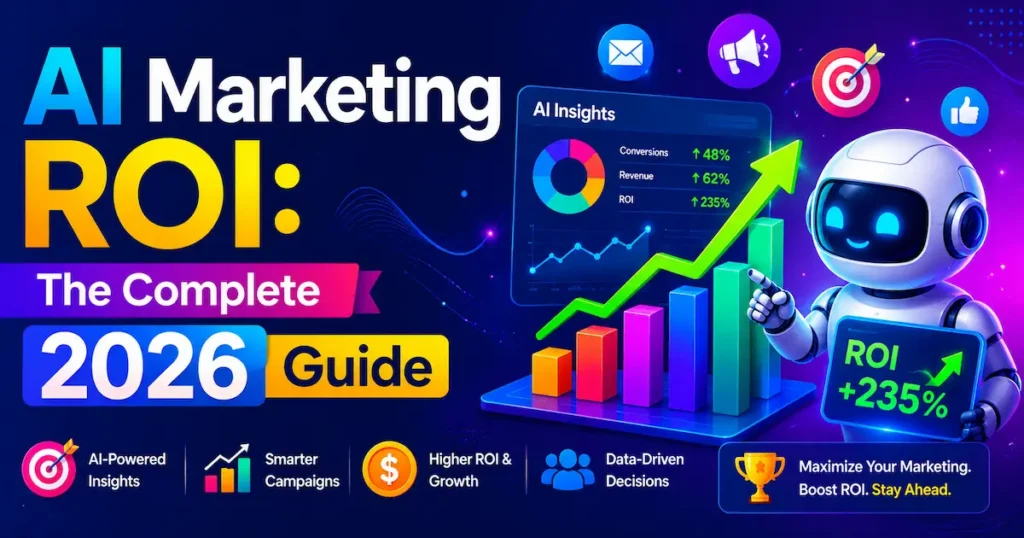
The futuristic AI marketing ROI is no longer a buzzword on a slide deck — it’s the number your boss, your client, or your own bank account is asking about right now. And if you can’t answer it confidently, you’re flying blind.
Here’s the thing: most marketers are using AI tools. But very few know whether those tools are actually making them money. In this guide, you’ll learn exactly how AI drives measurable marketing returns, which tools deliver the best results, and how to track performance so nothing gets wasted. Whether you’re a freelancer in Australia, a small business owner in the UK, or a digital marketer in the USA, this guide is built for you.
Let’s get into it.
What Is AI Marketing ROI (And Why It's Different From Traditional ROI)
ROI stands for Return on Investment. In marketing, it’s simple: you spend money, you measure what comes back. Traditional marketing ROI is calculated as:
ROI = (Revenue from Campaign − Campaign Cost) ÷ Campaign Cost × 100
AI marketing ROI follows the same formula — but the inputs look very different.
When you add AI to your marketing stack, you’re not just buying an ad. You’re automating work, personalizing experiences, optimizing bids in real time, and generating content at scale. The “cost” now includes your tool subscriptions, your time setting things up, and any training your team needs. The “return” shows up across multiple channels — faster campaigns, lower ad costs, better conversion rates.
Why the ROI from AI Is Often Underestimated
Most marketers measure AI ROI too narrowly. They look at one campaign, one tool, or one metric. But AI’s real value compounds across workflows. A tool that saves your copywriter 6 hours a week doesn’t just cut salary costs — it frees them to do higher-value work, which drives more revenue.
The other hidden return? Speed. Companies using AI in marketing in 2026 report campaigns that launch 75% faster than those built manually. Faster campaigns mean faster feedback loops, which means faster growth.
Key Takeaway: AI marketing ROI measures more than revenue — it includes time saved, speed gained, and compounding efficiency across your entire marketing operation.
5 Ways AI Directly Improves Marketing ROI in 2026
These aren’t hypothetical gains. These are the specific levers AI pulls on to move your numbers.
1. Smarter Ad Targeting
AI analyzes audience signals — browsing behavior, purchase history, engagement patterns — and adjusts targeting in real time. Human marketers can’t process that data fast enough. AI can. AI for customer targeting led to 40% higher conversion rates and 35% increases in average order values in 2026 benchmarks.
Less wasted spend. More of your budget reaches people who actually buy.
2. Personalization at Scale
Sending the same email to 10,000 people is old marketing. AI lets you personalize every touchpoint — subject lines, product recommendations, retargeting ads — without having to do it manually. Personalization reduced customer acquisition costs by half while lifting marketing ROI by 10–30%.
For small businesses in Canada and Australia, where ad budgets are tighter, this kind of efficiency is a gamechanger.
3. Content That Actually Ranks
AI content drafting delivers 3.2x ROI on average, per McKinsey’s Global AI Survey. The key isn’t replacing your content team — it’s using AI to draft faster, then editing for quality and voice. The result is more content, published faster, with proportionally less cost.
4. Predictive Analytics
Instead of waiting to see what happened last quarter, AI-powered analytics tools tell you what’s likely to happen next. You can shift the budget before a campaign underperforms, not after. 92% of top-performing marketing teams in 2025 relied on AI-powered predictive analytics.
5. Marketing Automation That Pays for Itself
Email sequences, lead scoring, follow-up workflows — AI runs these 24/7 without burning out. Marketing automation leads all AI categories with a staggering 544% ROI. That’s not a typo.
Pro Tip:
Start with just one AI-powered automation — like an abandoned cart email sequence or a lead nurturing workflow. Get that working first, measure the result, and then add more. Trying to automate everything at once leads to messy data and unclear attribution.
Key Takeaway: AI improves marketing ROI across five compounding levers — targeting, personalization, content, prediction, and automation — and the gains stack the more consistently you apply them.
Best AI Marketing Tools to Maximize ROI in 2026
Not all AI marketing tools are equal. Some are genuinely powerful. Some are expensive wrappers around basic features. Here’s a comparison of the tools that are actually worth your money in 2026.
These tools are used by marketers across the USA, UK, Canada, and Australia — and most have pricing in both USD and GBP.
| Tool | Best For | Free Plan | Starting Price | Our Rating |
|---|---|---|---|---|
| HubSpot AI | Full-funnel CRM + automation | ✅ Yes | $18/mo (USD) / £16/mo (GBP) | ⭐⭐⭐⭐⭐ |
| Jasper | AI copywriting & content drafts | ❌ No | $39/mo (USD) / £32/mo (GBP) | ⭐⭐⭐⭐ |
| Semrush | SEO + content marketing AI | ✅ Limited | $139/mo (USD) / £110/mo (GBP) | ⭐⭐⭐⭐⭐ |
| Manychat | Social media & chatbot automation | ✅ Yes | $15/mo (USD) / £12/mo (GBP) | ⭐⭐⭐⭐ |
| AdCreative.ai | AI-generated ad creatives | ❌ No | $29/mo (USD) / £23/mo (GBP) | ⭐⭐⭐⭐ |
| Klaviyo AI | Email & SMS personalization | ✅ Yes | $20/mo (USD) / £16/mo (GBP) | ⭐⭐⭐⭐⭐ |
| Surfer SEO | AI content optimization for SEO | ❌ No | $99/mo (USD) / £79/mo (GBP) | ⭐⭐⭐⭐ |
For most small businesses and freelancers just getting started, HubSpot AI or Klaviyo offer the best combination of features and value — especially if email marketing is a core part of your strategy.
📊 87% of marketers use generative AI in at least one workflow in 2026, up from 51% in 2024 — Salesforce State of Marketing, 2026
Key Takeaway: The best AI marketing tool is the one that fits your current stage — start with what solves your biggest bottleneck, not the flashiest option on the market.
How to Build an AI Marketing Strategy That Actually Delivers Results
Having AI tools and having an AI marketing strategy are two very different things. Most marketers who fail with AI don’t fail because the tools don’t work — they fail because they have no structure around how they use them.
Here’s a framework that works for freelancers, agencies, and small businesses alike.
Step 1: Audit Your Current Marketing Gaps
Before adding AI, identify where you’re losing money or time right now. Is it in content production? Ad targeting? Lead follow-up? Lead scoring? Pick the biggest leak first.
Step 2: Match a Tool to Each Gap
Don’t buy tools looking for a problem. Buy tools that solve the specific gap you already identified. If your ad creative is underperforming, start with AdCreative.ai. If your email open rates are low, Klaviyo’s AI segmentation is where to focus.
Step 3: Set Baseline Metrics Before You Start
This is the step most people skip — and it kills their ability to prove ROI later. Before turning on any AI tool, write down your current numbers: cost per lead, email open rate, conversion rate, and ad ROAS. These are your baselines.
Step 4: Run a 60-Day Test, Then Evaluate
Give each tool 60 days of consistent use before judging it. AI tools often improve as they gather more data. Turning them off after two weeks because results aren’t instant is one of the most common (and costly) mistakes.
Real Example
A freelance digital marketer in Australia used Klaviyo’s AI segmentation and predictive send-time feature to revamp a client’s email strategy. Within 8 weeks, the client saw a 41% increase in email revenue and a 27% reduction in unsubscribes — without increasing their email frequency. Source: Klaviyo Customer Stories — klaviyo.com/resources/case-studies
Key Takeaway: A successful AI marketing strategy is built on identifying real gaps, setting measurable baselines, and giving each tool enough time to generate meaningful data before making changes.
3 AI Marketing Mistakes That Kill Your ROI
Most AI marketing guides tell you what to do. This section tells you what not to do — because these three mistakes are eating budgets right now across the UK, USA, and beyond.
Mistake 1: Using AI to Create More Content Without a Distribution Strategy
AI makes it easy to publish 30 blog posts a month. But if no one reads them, your ROI is zero. Before scaling content with AI, make sure you have SEO, email, or social distribution lined up. Volume without strategy is just noise.
Mistake 2: Automating Everything Before You Understand What Works Manually
If you don’t know why your current best email converts, you can’t automate it effectively. AI amplifies what works — it doesn’t fix what’s broken. Spend time understanding your top-performing campaigns first, then automate the pattern.
Mistake 3: Ignoring the Data AI Gives You
This one is surprising but common. AI marketing tools like HubSpot and Klaviyo generate enormous amounts of behavioral data. Most small businesses look at the output (revenue, clicks) but ignore the insights (which segments converted, which subject lines failed). The insights are where the real value is.
💡 Pro Tip: Set a recurring 30-minute weekly review in your calendar where you look at one AI tool’s data report. Not to act on everything — just to spot one pattern worth testing. Small, consistent optimizations compound faster than big quarterly overhauls.
Key Takeaway: The most common AI marketing mistakes aren’t technical — they’re strategic. Fixing them costs nothing but attention.
How to Measure AI Marketing Performance the Right Way
You can’t improve AI for marketing performance if you’re measuring the wrong things. Here’s what to actually track.
The 4 Metrics That Matter Most
1. Revenue Attributed to AI Touchpoints Use UTM parameters and your CRM to tag which leads and sales are touched by an AI-driven workflow. HubSpot and Salesforce both support this natively.
2. Cost Per Acquisition (CPA) Before vs. After AI: Compare your CPA from 90 days before using AI tools to 90 days after. If it went down, AI is working. If it didn’t, something in your setup is off.
3. Time Saved Per Week. This sounds soft, but it directly impacts ROI. HubSpot AI Trends 2026 reports marketers recover 6.1 hours weekly on average. At even $50/hour for a freelancer, that’s $300/week in recaptured value — $15,600/year.
A Simple Reporting Template
Every month, track this in a spreadsheet or Google Data Studio:
- Total AI tool spends (USD or GBP)
- Revenue directly attributed to AI workflows
- Hours saved × your hourly rate
- Change in CPA (%)
- Change in conversion rate (%)
Add these up, divide revenue + time savings by your total AI spend, and you have a clean AI marketing ROI number to report or act on.
Key Takeaway: Measuring AI marketing performance means combining hard revenue metrics with soft efficiency metrics — together, they tell the full story of what your investment is actually returning.
Frequently Asked Questions
AI marketing ROI measures the return you get from investing in AI-powered marketing tools and strategies. You calculate it by comparing the revenue and efficiency gains generated through AI (including time saved) against the total cost of your AI tools and setup. A simple formula: (Revenue from AI-driven efforts + Monetary value of time saved − AI tool costs) ÷ AI tool costs × 100.
Most AI marketing tools start showing measurable results within 30 to 90 days, depending on the tool and how consistently you use it. Tools like email AI and ad optimization tend to show faster results. Content SEO tools typically take 60–90 days to reflect in organic traffic.
Yes — especially for small businesses with limited budgets. AI tools let small teams compete with larger ones by automating time-consuming tasks like email personalization, ad optimization, and content drafting. The key is starting with one tool that addresses your biggest bottleneck, not trying to implement everything at once.
Based on 2026 data, marketing automation tools (especially email AI platforms like Klaviyo) and AI content drafting tools consistently deliver the highest ROI. Marketing automation leads all AI categories with a 544% ROI. Ad creative tools and predictive analytics platforms are close behind.
Start with free plans. HubSpot, Manychat, and Klaviyo all offer free tiers that provide genuine value. Focus on one workflow — like automating your email follow-up sequence — and measure its impact before spending more. Even $20–$30/month on the right AI tool can return multiples if used consistently.
Yes. The major AI marketing platforms — HubSpot, Klaviyo, Jasper, Semrush, and others — are fully available in the UK, Canada, and Australia with local currency pricing and support. Some tools price in USD only, but most now offer GBP and AUD billing options.
The most common reasons are: not setting baseline metrics before starting, switching tools too quickly before they gather enough data, or using AI without a distribution strategy behind it. AI amplifies what's already working — if your fundamentals (offer, audience, messaging) are off, AI won't fix that.
No. AI automates execution tasks like drafting copy, testing ad variations, and scoring leads. It does not replace positioning, brand direction, or growth strategy. The marketers thriving in 2026 are the ones using AI to handle repetitive tasks so they can focus on strategy, creativity, and relationships.
Companies using AI in marketing in 2026 report a 22% higher ROI and 32% more conversions compared to non-AI teams. Enterprise teams average 3.4x blended ROI, mid-market 2.8x, and SMBs around 2.3x — all positive returns when AI is used strategically.
Track four core metrics: revenue attributed to AI-assisted workflows, change in cost per acquisition before and after AI, hours saved per week (converted to a monetary value), and content-to-conversion rate. Review these monthly, and compare them to your pre-AI baseline for a clear picture of what's working.
Final Thoughts
AI marketing ROI is real, measurable, and available to marketers at every level — not just enterprises with massive budgets. The evidence is clear: companies using AI in marketing Roi metrics consistently outperform those that don’t, across conversion rates, content output, and cost efficiency. The tools are accessible, many are affordable or free to start, and the framework for measuring results is straightforward once you set it up correctly.
The marketers who will win in the next 12 months aren’t the ones with the most AI tools — they’re the ones who pick the right tool, measure it honestly, and keep optimizing. You now have everything you need to be one of them.