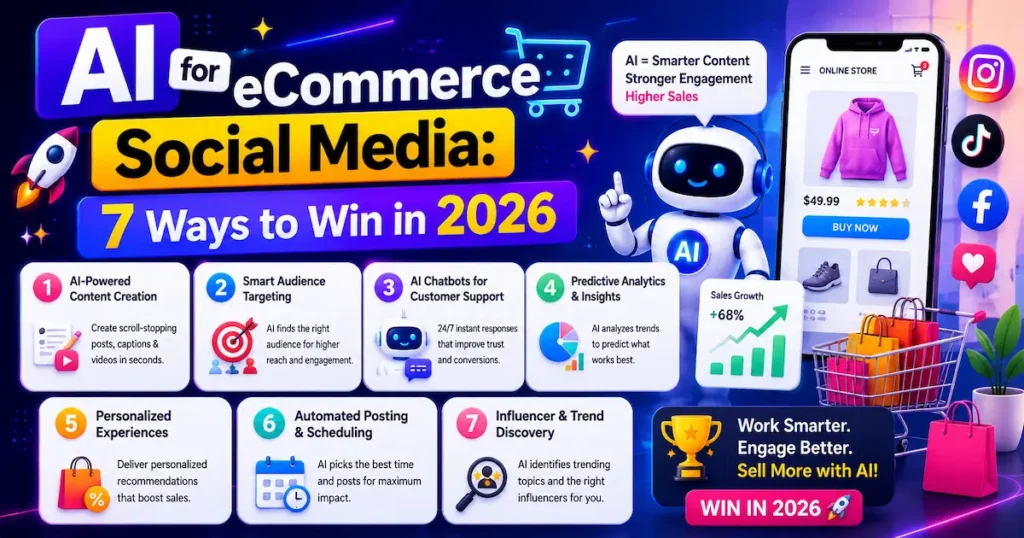
The futuristics AI for e-commerce social media is no longer a competitive edge — it’s the new baseline. In 2026, 85% of businesses use AI for social media marketing, up from just 42% in 2023. If you’re still manually writing captions, designing posts one by one, and guessing the best time to publish, you’re burning hours your competitors are saving. This guide breaks down exactly how AI works across every stage of your eCommerce social strategy — from content creation and scheduling to paid ads and analytics. By the end, you’ll know which tools to use, what mistakes to avoid, and how to build a system that actually scales.
What AI for eCommerce Social Media Actually Does (and Why It Matters Now)
Most people think AI just writes captions. It does a lot more than that.
AI tools for eCommerce social media handle content ideation, visual creation, post scheduling, hashtag research, performance analytics, audience targeting, and even customer replies. These aren’t isolated tasks — when connected properly, they form an automated pipeline that keeps your brand active 24/7 without burning out your team.
The Scale Problem AI Solves
Running an eCommerce brand across Instagram, TikTok, Facebook, Pinterest, and LinkedIn used to require a full marketing department. Now, a solo founder or a two-person team in the USA, UK, Canada, or Australia can manage all five platforms with a lean AI-powered stack.
📊 Marketers using AI tools save an average of 6.1 hours per week on content tasks, with senior practitioners saving 8–10 hours. — HubSpot AI Trends Report, 2026
That time goes straight into strategy, product development, and customer relationships — the things AI can’t do for you.
Why eCommerce Specifically Benefits
Unlike B2B brands, eCommerce businesses post constantly. New products, flash sales, seasonal campaigns, user-generated content — the content calendar never stops. AI handles the repetitive, high-volume work so your creative energy goes toward the decisions that actually move revenue.
Key Takeaway: AI doesn’t replace your social media strategy — it executes it faster and at greater scale than any human team could match manually.
5 Ways AI Transforms Your eCommerce Social Media Strategy
Here’s where the practical value lives. These aren’t theoretical benefits — they’re capabilities you can switch on this week.
1. AI Content Generation at Scale
Tools like Jasper, Copy.ai, and Buffer AI Assistant generate platform-specific captions, product descriptions, and ad copy from a single prompt. You give the tool your product name, key benefit, and target audience. It produces five caption variants in 30 seconds. You pick the best one and move on.
2. Smart Scheduling and Optimal Posting Times
Posting at the wrong time costs you reach. AI scheduling tools analyze your specific audience behavior — not generic industry benchmarks — and recommend exact publish times per platform. Marketers who switched to AI-recommended posting schedules reported engagement lifts of 15% to 30%, according to a 2026 Sprout Social benchmark.
3. Visual Content Creation Without a Designer
Canva’s AI tools, Adobe Express, and similar platforms let eCommerce brands generate on-brand product graphics, promotional banners, and social carousels without hiring a designer. For small businesses in Australia and Canada, where agency costs are high, this alone can save thousands of dollars per year.
4. Automated Performance Analytics
Instead of exporting data from five different platforms and building spreadsheets, AI analytics tools like Sprout Social and Hootsuite pull everything into one dashboard, surface your top-performing content, and flag declining metrics before they become problems. You get insight in minutes instead of hours.
5. Social Listening and Competitor Tracking
AI tools monitor brand mentions, competitor campaigns, and trending conversations in real time. When a relevant trend hits your niche, you can react immediately with content — instead of finding out three days later when the moment has passed.
- AI client communication tools help businesses respond to social media messages faster.
- They automate customer interactions across platforms like Facebook, Instagram, and LinkedIn.
💡 Pro Tip: Start with just one AI capability — caption writing — and master it before adding scheduling and analytics. Most people overcomplicate their stack before they’ve built a consistent posting habit.
Key Takeaway: AI for eCommerce social media works best as a connected system, not a collection of isolated tools. Pick one workflow to automate first, then expand.
Best AI Tools for eCommerce Social Media in 2026
Choosing the wrong tool wastes money and time. Here’s a clear comparison of the platforms that genuinely deliver for eCommerce brands in 2026 — all tested and widely used across the USA, UK, Canada, and Australia.
These tools were evaluated on content quality, eCommerce integrations (especially Shopify and WooCommerce), ease of use for beginners, and value for small business budgets.
| Tool | Best For | Free Plan | Starting Price (USD / GBP) | Our Rating |
|---|---|---|---|---|
| Buffer AI Assistant | All-in-one scheduling + content creation | ✅ Yes | $6/mo / £5/mo | ⭐⭐⭐⭐⭐ |
| Hootsuite + OwlyWriter AI | Teams managing multiple brands | ✅ Limited | $99/mo / £79/mo | ⭐⭐⭐⭐ |
| Canva AI | Visual content + brand templates | ✅ Yes | $15/mo / £12/mo | ⭐⭐⭐⭐⭐ |
| Jasper AI | Long-form captions + ad copy | ❌ No | $49/mo / £39/mo | ⭐⭐⭐⭐ |
| Sprout Social | Advanced analytics + scheduling | ❌ No | $199/mo / £159/mo | ⭐⭐⭐⭐⭐ |
| SocialBee | Content recycling + category management | ✅ Limited | $29/mo / £23/mo | ⭐⭐⭐⭐ |
| Predis.ai | eCommerce-specific visual posts | ✅ Yes | $29/mo / £23/mo | ⭐⭐⭐⭐ |
Our recommendation for most eCommerce businesses: Start with Buffer AI Assistant for scheduling and content, paired with Canva AI for visuals. That combination covers 80% of your social media needs for under $25/month (around £20/month).
Key Takeaway: You don’t need an enterprise-level tool to get enterprise-level results. Buffer and Canva together are more effective for most small eCommerce brands than expensive all-in-one platforms.
How to Automate eCommerce Content Without Losing Your Brand Voice
This is the biggest fear. And it’s valid — AI-generated content can sound generic if you let it run on autopilot.
The solution isn’t to avoid AI. It’s to train it properly before you deploy it.
Build a Brand Voice Document First
Before you write a single AI prompt, document your brand’s tone, vocabulary, and content rules. What words do you always use? What’s off-limits? Who is your ideal customer? Feed this into every AI tool you use — most platforms have a “brand voice” settings section where you can save these instructions permanently.
Use AI for Drafts, Humans for Final Approval
The smartest eCommerce teams in 2026 use AI for first drafts and human judgment for final approval. AI generates five caption options in 30 seconds. A team member picks the best one, adds a personal touch, and hits publish. The whole process takes under five minutes — versus 20 minutes of staring at a blank screen.
Repurpose Existing Content Intelligently
AI excels at transforming one piece of content into multiple formats. One product blog post becomes five Instagram captions, three TikTok scripts, and a LinkedIn article. Tools like Buffer and Jasper do this automatically. For eCommerce brands with large product catalogs, this is a significant time-saver.
📌 Real Example: A Shopify store owner in the UK selling handmade skincare products used Predis.ai to generate platform-specific product posts for their 40-item catalog. Within 8 weeks, their Instagram engagement rate increased by 34% and monthly social traffic to their store grew by 22%, without hiring additional staff. Predis.ai eCommerce case studies →
Key Takeaway: AI is only as good as the instructions you give it. Investing 30 minutes in a brand voice setup saves hours of editing every single week.
AI Social Media Ads: Spend Less, Convert More
Organic content builds audiences. Paid ads build revenue. AI is changing both sides of that equation.
AI-Powered Ad Creative
Tools like Meta Advantage+ and Google Performance Max use AI to generate and test multiple ad variations automatically. You upload your product images and copy, and the AI runs hundreds of creative combinations to find the highest-performing version — without manual A/B testing.
For eCommerce brands spending $500–$5,000 per month on social ads in the USA or Canada, this optimization can meaningfully reduce cost per acquisition within the first 30 days.
Audience Targeting and Lookalike Modeling
AI identifies which customer segments convert best and automatically builds lookalike audiences to target new users with similar behavior. This is no longer an advanced feature — it’s built into Facebook Ads Manager, TikTok Ads, and Pinterest Ads at no extra cost.
Predictive Analytics for Ad Timing
Some advanced tools predict when your target audience is most likely to convert based on historical behavior, seasonality, and external signals. Running ads at AI-recommended times reduces wasted spend significantly. AI customer feedback tools identify customer sentiment and highlight common concerns automatically.
💡 Pro Tip: Don’t use AI to generate your final ad creative without a human review. Meta, TikTok, and Google have all updated their 2026 ranking algorithms to quietly reduce reach for content that reads as obviously AI-generated. Use AI as a starting point, then personalize.
Key Takeaway: AI-powered ad tools reduce wasted spend and improve targeting accuracy — but they still require human oversight to maintain brand authenticity and ad quality.
Real Results: What Happens When eCommerce Brands Go All-In on AI
The question most business owners ask is: Does this actually work at scale?
The data says yes — but with caveats.
What the Numbers Show
According to a 2026 Salesforce survey, generative AI saved marketers five hours per week on content tasks. A separate HubSpot benchmark reported that 78% of marketers saw increased productivity after implementing AI social media tools. The median payback period on AI tool investments is now 4.2 months — down from 7.8 months in 2024.
For e-commerce specifically, AI adoption in social media translates directly to content consistency. Consistent posting is one of the strongest predictors of organic reach growth on Instagram, TikTok, and Pinterest. Brands that post consistently outperform brands that post occasionally — regardless of creative quality. Better customer insights lead to higher satisfaction, loyalty, and retention through AI customer feedback tools.
What Doesn't Work
AI video tools still underperform compared to human-produced video. Meta, TikTok, and Google have updated their 2026 ranking algorithms to reduce the reach of obviously AI-generated video content. Raw AI video output performs 20–40% worse on average than human-directed content.
The winning approach for Australian and UK eCommerce brands is hybrid: use AI for static content, captions, and scheduling, while keeping video production human-led.
The Strategy That Consistently Works
Build a simple three-tool stack: one scheduling tool (Buffer), one visual tool (Canva), and one analytics tool (Sprout Social or a free alternative like Google Analytics + native platform insights). Automate the content calendar. Review performance weekly. Adjust monthly. That’s the entire system.
Key Takeaway: AI delivers real, measurable results for eCommerce social media — but the brands that win use AI as infrastructure, not a replacement for strategy and human creativity.
Frequently Asked Questions
AI for e-commerce social media refers to tools and technologies that automate, optimize, and enhance social media marketing for online stores. This includes content generation, scheduling, visual design, audience targeting, performance analytics, and customer engagement. The goal is to save time, improve consistency, and increase revenue from social channels.
AI handles repetitive tasks like writing captions, generating hashtags, scheduling posts, and reporting on performance. According to HubSpot's 2026 AI Trends Report, marketers using AI tools save an average of 6.1 hours per week. For small eCommerce teams, this means more time for product development, customer service, and business strategy.
The top tools in 2026 are Buffer AI Assistant (best all-in-one for small teams), Canva AI (best for visuals), Jasper (best for ad copy), Sprout Social (best for analytics), and Predis.ai (best for eCommerce-specific visual content). Most small businesses in the USA and UK can get excellent results from Buffer and Canva combined, starting at around $21/month.
Yes. AI tools like Meta Advantage+ and Google Performance Max automatically test ad variations and optimize targeting to reduce cost per acquisition. For eCommerce brands running paid social, AI can meaningfully lower ad spend while maintaining or improving results. However, human review of AI-generated ad creative is still recommended in 2026, as platforms now reduce reach for obviously AI-generated content.
AI can automate scheduling, content generation, hashtag research, and performance reporting. However, full automation without human oversight reduces content quality and audience engagement over time. Most successful eCommerce brands use AI for 70–80% of their workflow, with humans handling strategy, community management, and final content approval.
Yes. Many of the best AI tools have free plans or start at $6–$29 per month. Buffer's free plan supports up to three social channels. Canva AI's free tier covers basic design needs. For small businesses in Canada or Australia where marketing budgets are tight, a two-tool AI stack can replace thousands of dollars per month in agency or freelancer fees.
Social media algorithms reward accounts that post regularly. Brands that post consistently get more organic reach, more profile visits, and more sales than brands that post sporadically — regardless of content quality. AI removes the biggest barrier to consistency: time. With AI scheduling tools, you can prepare and queue an entire month of content in a single afternoon.
The most effective approach is to build a brand voice document that defines your tone, vocabulary, writing style, and audience before using any AI tool. Most platforms let you save these instructions permanently. Always use AI to generate drafts, not final content — have a human review and edit before publishing. This hybrid approach gives you the speed of AI with the authenticity of human writing.
Results vary based on your niche, audience size, and how consistently you use the tools. Realistic expectations for the first 90 days include a 15–30% lift in engagement rates (per Sprout Social benchmarks), 20–40% reduction in time spent on content creation, and improved posting consistency across all platforms. Revenue impact depends on your offer, funnel, and ad spend, but brands that increase content consistency typically see meaningful organic traffic growth within three to six months.
Instagram and TikTok are the highest-performing platforms for e-commerce in 2026, driven by social commerce features including shoppable posts and live stream purchasing. Pinterest remains strong for discovery in home, beauty, and fashion niches. Facebook still delivers results for older demographics and paid advertising. For most small eCommerce brands, a focused presence on two or three platforms outperforms a scattered presence across five or six.
Final Thoughts
AI for eCommerce social media works — but it works best when you treat it as infrastructure, not magic. The brands seeing real results in 2026 are using AI to create consistent content, automate their scheduling, optimize their ads, and analyze performance without drowning in data. They’re not replacing strategy with automation; they’re using automation to execute strategy faster. If you’re a freelancer, small business owner, or digital marketer running an eCommerce brand, the tools covered in this guide are accessible, affordable, and genuinely effective from day one.
Your competitors are already using AI. The gap between brands that adopt it now and those that don’t is growing every month. Pick one tool, start with one workflow, and build from there — the results will show you exactly where to go next.