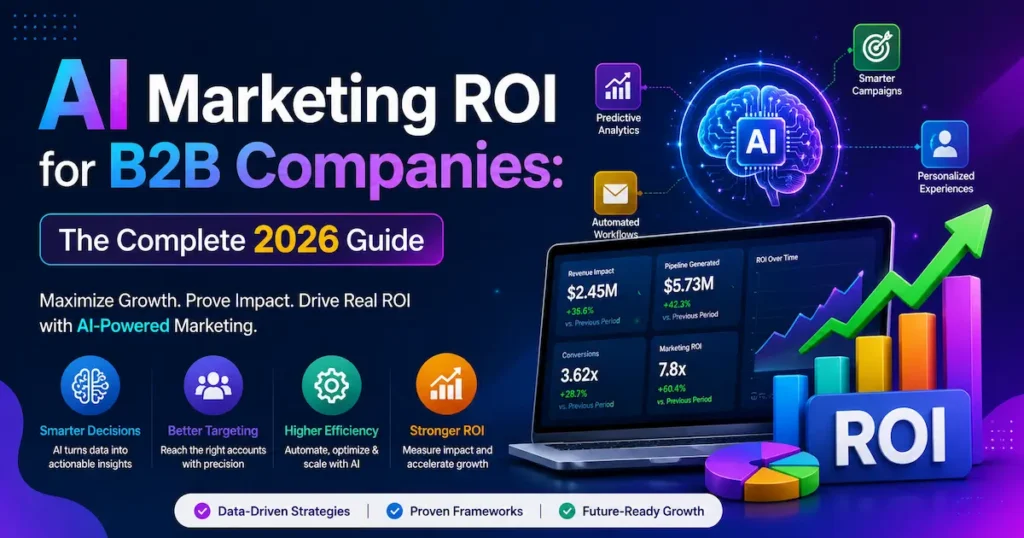
AI marketing ROI for B2B companies is no longer a future ambition — it’s a present-day pressure point. A 2026 report found that only 41% of marketers can actually prove the ROI of their AI investments, even though 91% now use AI tools daily. That gap is costing businesses real money, lost pipeline, and boardroom credibility.
This guide cuts through the noise. You’ll learn exactly what AI marketing ROI means in a B2B context, where AI genuinely moves the needle, which tools deliver the best returns, and how to build a measurement framework that actually works — whether you’re running campaigns in the USA, UK, Canada, or Australia.
Let’s start with why this problem exists in the first place.
Why B2B Companies Are Struggling to Prove Marketing ROI
Most B2B marketing teams aren’t failing because AI doesn’t work. They’re failing because they’re measuring the wrong things.
In futuristics, the 2026 State of AI and B2B Marketing report found that 71% of B2B firms use AI primarily to produce content, and 56% measure AI success by volume of output — blog posts published, emails sent, ads created. That’s an activity metric, not a business metric. Your CFO doesn’t care how many social posts you scheduled. They care about the pipeline.
The Tactical Trap
The pattern is consistent: teams adopt AI for safe, low-risk tasks first. Drafting subject lines. Summarizing meeting notes. Resizing ad creatives. These tasks feel productive but rarely tie to revenue.
High-maturity B2B organizations do something different. They map AI use cases directly to business outcomes — pipeline generated, cost per acquisition, sales cycle length. That discipline is what separates teams achieving 116% ROI from teams just checking AI off a buzzword list.
The Measurement Gap
Manual reporting and analysis consume more than 10 hours per week for most B2B marketing teams — yet many teams have no baseline to compare against before AI was introduced. Without a baseline, you can’t measure improvement. Without measurement, you can’t justify investment. Improvado
The fix isn’t complicated. It just requires intentionality before you deploy, not after.
Key Takeaway: Most B2B companies are measuring AI activity, not AI impact — and that’s the root cause of their ROI problem.
What AI Marketing ROI Actually Means (and How to Measure It)
ROI in AI marketing has two dimensions: cost savings and revenue impact. Most teams only track one.
Cost Savings from AI
This side is easier to quantify. It includes reduced time on manual tasks, fewer tools in your stack (consolidation), lower content production costs, and faster campaign turnaround. The average marketer saves 6.1 hours per week through AI, with senior practitioners recovering 8–10 hours — time that can be redirected toward strategy and relationship-building. Digital Applied
At $75/hour blended rate for a B2B marketing manager, 6 hours weekly equals roughly $23,400 per year in recovered time — per person.
Revenue Impact from AI
This side takes more work but matters more. It includes improved lead quality from AI scoring, higher conversion rates from personalized nurturing, shorter sales cycles from smarter engagement timing, and better budget allocation from predictive analytics.
AI-driven campaigns deliver 22% higher ROI, 32% more conversions, and 29% lower acquisition costs than traditional methods, according to McKinsey and Zebracat AI benchmarks. BizIQ
Your 3 Core Metrics
Track these three numbers before and after AI implementation:
- Cost per Marketing Qualified Lead (MQL) — AI should reduce this over time
- MQL-to-SQL conversion rate — AI lead scoring should improve this
- Time-to-revenue — AI nurturing should shorten this
📊 Companies using AI in marketing see 22% higher ROI and 32% more conversions than teams using traditional methods — McKinsey Global AI Survey, 2026
Key Takeaway: Measure AI ROI across both cost savings and revenue impact — tracking only one gives you an incomplete (and often misleading) picture.
5 High-Impact Areas Where AI Drives Measurable B2B ROI
Not all AI applications are created equal. These five deliver the clearest, fastest returns in B2B marketing.
1. Predictive Lead Scoring
AI analyzes behavioral signals — page visits, email opens, content downloads, firmographic data — and ranks leads by purchase intent. Predictive lead scoring delivers a 25–40% improvement in SQL rates, meaning your sales team spends time on leads far more likely to close.
2. AI-Powered Email Personalization
Generic email blasts are dead in B2B. AI personalizes send times, subject lines, body content, and CTAs at the individual level. AI email personalization drives 26% higher open rates — a meaningful lift when your sequences run into hundreds of decision-makers per account.
3. Content Drafting and Scaling
AI content drafting delivers 3.2x ROI — the highest of any AI marketing application, according to the McKinsey Global AI Survey. For B2B teams producing whitepapers, case studies, landing pages, and LinkedIn content simultaneously, this is a genuine multiplier.
4. Paid Campaign Optimization
AI-powered bidding tools like Google Smart Bidding and Meta Advantage+ improve ROAS by 20–35% versus manual management — and do it within weeks, not quarters.
5. Marketing Analytics and Attribution
AI connects every touchpoint to revenue, giving you clear visibility into which campaigns actually drive pipeline. This alone makes it easier to cut wasted spend and double down on what’s working.
💡 Pro Tip: Start with lead scoring before anything else. It’s the fastest path to a stat your sales director and CFO will both care about — more qualified leads without increasing headcount.
Key Takeaway: The five highest-ROI AI applications in B2B marketing are lead scoring, email personalization, content drafting, paid optimization, and AI attribution — in roughly that order of immediate impact.
Best AI Marketing Tools for B2B ROI in 2026
Here are the tools B2B marketing teams across the USA, UK, Canada, and Australia are using to drive measurable returns right now.
Below is a breakdown of the top platforms by use case, availability, and real cost:
|
Tool
|
Best For
|
Google Performance Max
|
Starting Price (USD / GBP)
|
Our Rating
|
|---|---|---|---|---|
|
HubSpot AI
|
All-in-one CRM + marketing automation
|
Yes (limited)
|
$800/mo / £630/mo
|
⭐⭐⭐⭐⭐
|
|
Jasper
|
AI content drafting at scale
|
No
|
$49/mo / £39/mo
|
⭐⭐⭐⭐
|
|
6sense
|
Predictive lead scoring + intent data
|
No
|
$1,500+/mo / £1,200+/mo
|
⭐⭐⭐⭐⭐
|
|
Drift (by Salesloft)
|
Conversational marketing + AI chat
|
No
|
$2,500/mo / £1,980/mo
|
⭐⭐⭐⭐
|
|
Madkudu
|
Pipeline prediction + lead qualification
|
No
|
Custom / Custom
|
⭐⭐⭐⭐
|
|
Persado
|
AI-generated emotional marketing copy
|
No
|
Custom / Custom
|
⭐⭐⭐⭐
|
|
Mutiny
|
Website personalization for B2B
|
No
|
$1,500+/mo / £1,200+/mo
|
⭐⭐⭐⭐⭐
|
Note: All tools listed are available to businesses in the USA, UK, Canada, and Australia as of 2026. HubSpot AI remains the most accessible entry point for small B2B teams because of its free tier and native CRM integration.
Key Takeaway: The right tool depends on your biggest bottleneck — start with one AI tool that solves your most urgent ROI problem, not the most impressive one in a demo.
3 Mistakes That Kill Your AI Marketing ROI
Knowing what not to do matters as much as knowing what to do. These three mistakes consistently derail B2B teams.
Mistake 1: Deploying AI Without Clean Data
AI SEO tools are only as good as the data they train on. If your CRM has duplicate records, stale contacts, and inconsistent field mapping, your AI lead scoring will make bad predictions, your personalization will fire incorrectly, and your analytics will mislead you. Data hygiene isn’t glamorous, but it’s a prerequisite — not an afterthought.
Mistake 2: Buying Too Many Tools at Once
91% of marketing teams have some AI in their stack, yet only 41% say they can prove the ROI. Tool sprawl is a major reason why. When five AI tools overlap in function, it’s impossible to attribute results to any one of them. Start with two or three tools maximum, prove ROI on each, then expand.
Mistake 3: Skipping Human Review on AI Outputs
This one cost B2B brands differently than it costs B2C brands. B2B buyers are sophisticated, skeptical, and high-stakes. An AI-generated email that sounds slightly off, or a personalization block that misfires, can damage a relationship that took months to build. AI speeds up production — human judgment ensures quality.
Key Takeaway: The biggest threats to AI marketing ROI aren’t the tools themselves — they’re dirty data, tool sprawl, and removing human judgment from the final mile.
Frequently Asked Questions
AI marketing ROI measures the financial return generated by AI-powered tools and strategies in B2B marketing, relative to their cost. It includes both hard savings (reduced production costs, fewer manual hours) and revenue impact (better lead quality, higher conversion rates, shorter sales cycles).
Most B2B teams see measurable results within 60–90 days when using AI for lead scoring or campaign optimization. Content and personalization tools may take 3–6 months to show clear ROI, depending on volume and testing cadence.
HubSpot AI, 6sense, and Mutiny consistently rank highest for B2B ROI in 2026 — covering CRM automation, intent-based lead scoring, and website personalization, respectively. The best tool depends on your biggest revenue bottleneck.
Yes. Platforms like HubSpot AI offer free or low-cost entry points, and even basic AI email personalization and content drafting deliver measurable time savings for small teams. Start with one use case, prove ROI, then scale.
Focus on three metrics: cost per MQL, MQL-to-SQL conversion rate, and content production cost per asset. Track these monthly in a simple spreadsheet before and after AI implementation — no data engineering required.
According to Salesforce's State of Marketing 2026, 91% of marketing professionals now actively incorporate AI tools into their daily workflows. Among B2B firms specifically, adoption is highest in content creation, lead scoring, and campaign analytics.
Yes. All major AI marketing platforms — including HubSpot, Jasper, 6sense, and Mutiny — operate fully in the UK and Australia, with local currency pricing and GDPR-compliant data handling for UK-based teams.
Most B2B teams measure AI by activity (content volume, emails sent) rather than business outcomes (pipeline generated, revenue influenced). Without pre-AI baselines and clear metric ownership per tool, any ROI calculation becomes guesswork.
AI is reshaping roles rather than eliminating them wholesale. Junior content roles are contracting, but demand for strategists, data-literate marketers, and AI tool specialists is growing. Teams that upskill alongside AI adoption outperform those that resist it.
Benchmarks vary by use case and maturity level. McKinsey data show that AI-driven campaigns deliver 22% higher ROI than traditional methods, while companies with mature AI programs report a 10–20% improvement in overall sales ROI. Businesses with high implementation discipline consistently outperform those treating AI as a plug-and-play solution.
Final Thoughts
AI marketing ROI for B2B companies comes down to three things: measuring the right metrics before you start, matching each AI tool to a specific business outcome, and maintaining human judgment throughout the process. Teams that skip any of these steps will keep running AI tools without knowing whether they’re working.
The gap between AI adoption and AI ROI is the biggest opportunity in B2B marketing right now. The businesses that close it — whether in the USA, UK, Canada, or Australia — won’t just save time. They’ll build a competitive edge that compounds every quarter. The tools are ready. The framework is clear. The only variable is execution.