What “ROI” Actually Means in AI Marketing Automation
Before comparing numbers, it helps to agree on what you’re measuring. AI marketing automation ROI isn’t just “did revenue go up”; it’s the return relative to what you spent on tools, setup time, and staff hours.
Most teams calculate marketing ROI one of two ways: cost savings (hours reclaimed, headcount avoided) or revenue lift (higher conversion, larger average order value, faster sales cycles). The strongest programs measure both.
Why This Definition Matters for Small Teams
A solo freelancer in the US automating client reporting isn’t chasing the same ROI as a 50-person marketing team in the UK running predictive lead scoring. Scale changes what “good ROI” looks like.
For a freelancer, saving six hours a week on a $20/month tool is a clear win. For a mid-sized business, ROI needs to show up in the P&L: lower cost-per-lead, shorter sales cycles, or measurable revenue lift.
Key Takeaway: Define ROI as time saved and revenue gained before you measure anything, or the numbers you collect won’t mean much.
The Real Numbers: AI Marketing Automation ROI Stats for 2026
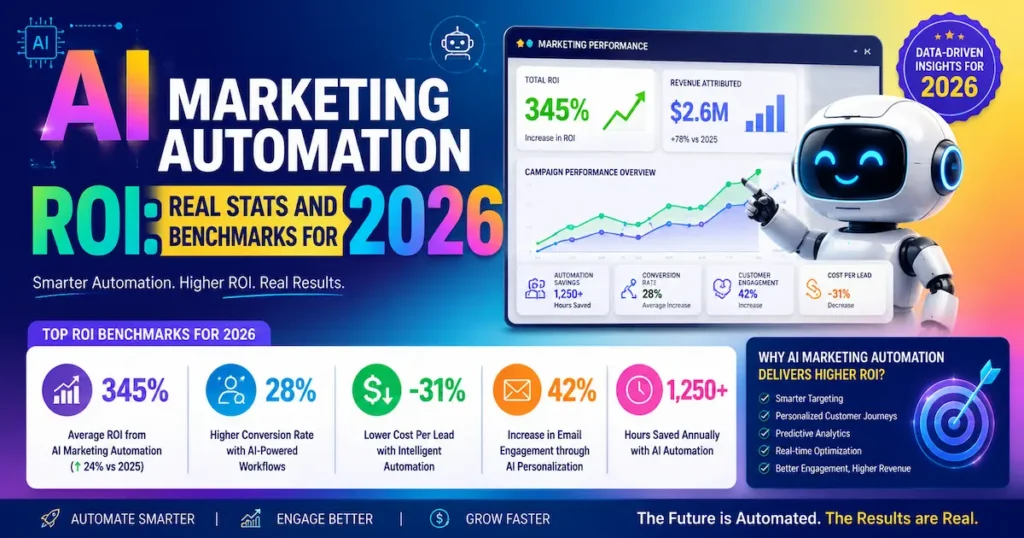
Here’s where it gets useful. Marketing automation for beginner programs returns an average of $5.44 for every $1 invested when you combine platform, content, and integration costs, based on Forrester Wave benchmarking data. That’s the headline figure, but it’s an average; top-quartile programs pull well ahead of laggards.
AI-driven campaigns specifically tend to deliver a 15–40% uplift in overall marketing ROI, largely through better targeting and lower acquisition costs. Companies that have fully adopted AI in marketing report customer acquisition costs dropping by roughly a third.
Content is where AI is currently earning its keep fastest. AI-assisted content drafting returns close to 3.2x on investment, and personalization engines return around 2.7x, according to McKinsey’s AI survey data. Audience research and ad copy generation sit just behind those two.
Marketing automation programs generate an average return of $5.44 for every $1 invested Forrester Wave, 2026
Key Takeaway: The average ROI across AI marketing automation sits well above break-even, but the spread between top and bottom performers is wide tool choice and task selection matter more than budget size.
Which AI Marketing Tasks Deliver the Highest ROI
Not every automated task pays off equally. Some tasks are consistently strong. Others quietly underdeliver, even when the tool itself is good.
The High-ROI Tasks
Content drafting, audience segmentation, and lead scoring are the clearest wins right now. Teams running AI agents on narrowly scoped workflows like re-engagement email sequences report returns in the 4x to 5x range on those specific tasks.
Email and SMS automation remain some of the most reliable levers available to small teams, particularly in ecommerce, where behavior-triggered flows convert far better than one-off campaigns.
The Underperforming Tasks
AI-generated video and AI-written paid social creative are currently the weakest categories. Production overhead for video stays high even with automation, and several major ad platforms have started down-ranking obviously AI-generated creative in 2026 which quietly caps its reach and ROI.
 Pro Tip: Start your AI automation with one high-ROI task like abandoned cart emails or lead scoring before expanding into content generation or paid social. Narrow scope beats broad rollout in the first 90 days.
Key Takeaway: Automate the tasks with clear, measurable triggers first email flows, segmentation, lead scoring and treat AI video and social creative as experiments, not core strategy.
How Long It Takes to See ROI From AI Marketing Automation
Patience matters more than people expect. The median payback period on AI marketing tooling now sits around 4.2 months, down from nearly 8 months in 2024 a sign that setup has gotten faster and tools have matured.
Content-heavy teams tend to see payback fastest, often within three months, because drafting and editing time savings show up almost immediately. Teams building more complex, multi-channel agent workflows should expect longer often two to four years for the ROI to fully mature.
Setting Realistic Expectations by Business Size
A freelancer or solo marketer using a single tool for one task (email flows, say) can often see measurable time savings within the first month.
A small business layering multiple tools CRM, email, content, and ad automation should plan for a 60 to 90 day ramp-up before ROI becomes visible in reporting.
Key Takeaway: Expect payback in three to four months for focused, single-tool automation, and closer to a year for multi-tool, multi-channel programs.
3 Mistakes That Quietly Kill AI Marketing ROI
Even good tools produce bad ROI when the setup is off. These three mistakes show up repeatedly across failed rollouts.
1. Automating without a success metric. Roughly 41% of failed agent deployments trace back to unclear goals the team automated something without agreeing on what “working” looks like.
2. Poor data access. AI tools are only as good as the data feeding them. A third of failed rollouts stem from disconnected CRM, email, and analytics data that never gets properly linked.
3. Letting AI creative go out unchecked. Brand-voice drift where AI-generated content sounds noticeably “off” to a real customer accounts for a meaningful share of automation failures and directly damages conversion rates.
 Real Example: A curly-hair care brand in the UK used AI-personalized content inside Klaviyo’s email automation platform to lift revenue per email sent by 29% across abandoned cart, browse abandonment, and cross-sell flows within a three-month trial. See the full case study here.
Key Takeaway: Most AI marketing ROI failures are process failures, not tool failures. Fix the goal-setting and data access before blaming the software.
How to Benchmark Your Own AI Marketing ROI
You don’t need enterprise reporting software to track this. Start with three numbers: hours saved per week, cost per lead before and after automation, and conversion rate on automated flows versus manual campaigns.
Businesses in Canada and Australia often underestimate currency and platform availability differences when benchmarking against US or UK case studies a $45/month Klaviyo plan in the US converts to roughly AU$68 or CA$61 depending on exchange rates, so budget benchmarks from American case studies need local adjustment.
Track your numbers monthly for the first 90 days. If cost per lead hasn’t moved and hours saved are minimal by month three, the task you automated probably wasn’t the right starting point revisit the high-ROI task list above before adding more tools.
Key Takeaway: Benchmark against your own baseline numbers, not industry averages local pricing, currency, and starting conditions vary too much for a single global benchmark to mean much.